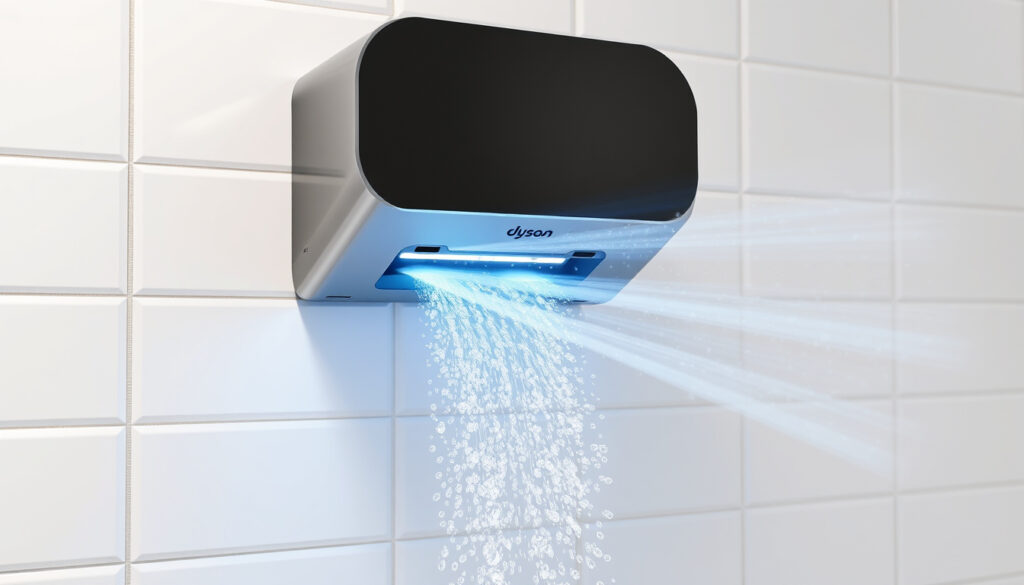
Dyson V Hand Dryer: Specs, Worth It, Problems & Guide
Walk into any busy airport washroom and you’ll probably hear it before you see it—a distinct whoosh of air scraping across a countertop. The Dyson Airblade V has been that sound since 2006, when Dyson launched its first hand dryer and essentially rewrote what “fast” means for drying hands. Over the years, the V model has carved out a reputation for high-speed drying and HEPA-filtered air, but it has also accumulated a fair share of complaints about noise and sticker shock. If you’re weighing whether this machine belongs in your building’s washroom, here’s what the specs and real-world reviews actually say.
Dry time: 12 seconds ·
HEPA capture: 99.97% of particles ·
Noise: 79–85 dB ·
Motor: 1000W digital ·
Wall protrusion: 4 inches
Quick snapshot
- 12-second dry time (Berls product comparison)
- HEPA filter captures 99.97% of particles (YouTube Review hands-on test)
- 1000W motor spins at 90,000 rpm (Qbic Washrooms technical review)
- Long-term reliability data from independent sources
- Precise annual running cost in specific markets
- Exact timeline for any model refresh
- Original Airblade launched in 2006 (Dyson Official site)
- V model introduced as quieter successor (Dyson Official site)
- 9kJ model now newer and faster (10s dry) (Dyson Official site)
- Airblade V still actively supported
- Manuals and spares available
- 5-year warranty on units
The table below pulls together the key specifications from official Dyson documentation and retailer verification.
| Specification | Value |
|---|---|
| Model | Airblade V (HU02, AB12) |
| Dry time | 12 seconds |
| HEPA filter | 99.97% capture |
| Wall protrusion | 4 inches (10 cm) |
| Motor | 1000W digital |
| Noise level | 79–85 dB |
| Airspeed | 430 mph |
| Finishes | Nickel, white/silver |
A reprogrammed motor and re-engineered airflows mean the Dyson Airblade V hand dryer is quieter than ever, yet still dries hands in just 12 seconds.
Are Dyson hand dryers worth it?
The math depends heavily on how many people walk through your washroom doors each day. For high-traffic locations handling over 300 uses per day, the Airblade V starts making financial sense against paper towels within a reasonable timeframe. According to Berls (product comparison site), the Airblade V can cost up to 78% less to run than comparable hand dryers and 99% less than paper towels over equivalent usage periods. Those are the numbers Dyson points to, and they hold up against the running cost data reported by Direct365 (facilities management provider), which measures the V at approximately 3.99 watt-hours per day.
The airflow is extremely powerful, feels like you are putting your hands inside a tornado.
The Airblade V pays for itself in months rather than years for washrooms serving hundreds of daily users. For a small office with a handful of employees, the upfront cost may never recover against cheap paper towels.
Cost vs performance
The Dyson Airblade V commands a premium purchase price compared to budget hand dryers, but its operating costs tell a different story. The digital motor produces 1000 watts and spins at 90,000 rpm, pushing air through 0.3 mm slits at 430 mph to scrape water off hands in 12 seconds, per Qbic Washrooms (washroom solutions specialist). That speed translates to less electricity per use than slower dryers that require 30 seconds or more.
User feedback
Real-world reviews paint a mixed picture. A Best Buy customer described the airflow as feeling like “putting your hands inside a tornado,” praising how well it works in an office setting, according to Best Buy reviews. However, a YouTube reviewer noted that hands often require at least 20 seconds to feel fully dry, suggesting the 12-second specification represents an ideal-condition benchmark rather than a universal experience, as documented in a hands-on review.
Comparison to paper towels
From an environmental standpoint, the Airblade V produces up to 88% less CO2 emissions than paper towels, according to a YouTube review. The hygiene question received independent validation through a study published in PubMed Central (peer-reviewed medical research), which found the Airblade technology superior to warm air dryers in reducing bacterial transfer after just 10 seconds of drying. Dyson also claims the Airblade V aerosolizes no more bacteria than paper towels, an assertion backed by independent testing cited by Berls.
The catch is that the Airblade V requires electricity to operate. If your washroom lacks dedicated circuits or faces frequent power outages, paper towels provide a fail-safe that the Airblade cannot match.
What are the benefits of the Dyson hand dryer?
The Airblade V builds its case around three pillars: speed, hygiene, and a quieter motor than its predecessors. Each benefit traces back to specific engineering choices documented across multiple review sources.
Speed and efficiency
At 12 seconds for a complete dry cycle, the Airblade V sits near the top of the high-speed hand dryer category. Intelligent Hand Dryers (specialist retailer) confirms this figure represents the rated performance under test conditions. The 1000W digital motor achieves this speed by generating 430 mph airspeeds through precision-cut apertures reduced to 0.55mm for quieter operation, as documented by Qbic Washrooms. For facilities managers calculating washroom throughput, that speed means shorter queues during peak periods.
Hygiene features
The HEPA filter captures 99.97% of particles as small as 0.3 microns, meaning the air blowing onto hands has already passed through a hospital-grade filtration system. According to Intelligent Hand Dryers, the Airblade V carries both NSF and HACCP certifications, meeting standards required in food processing and healthcare environments. The touch-free operation eliminates one more potential contact point, and Eco/Max modes let facilities choose between energy savings and maximum drying power.
Quiet operation
Dyson re-engineered the airflow paths and reprogrammed the motor to deliver the Airblade V at 30–35% quieter than its predecessor. Berls notes the V model achieves this without sacrificing the 12-second dry time. The Qbic Washrooms review cites a noise rating of 79 dB with Quiet Mark certification, though Direct365 recorded 85 dB in their testing environment. The discrepancy likely reflects different mounting conditions and acoustic surroundings rather than contradictory specifications.
The 79–85 dB range sits comfortably above normal conversation (60 dB) and approaches city traffic noise levels. For open-plan washrooms in boutique hotels or small professional offices, this volume may draw complaints. For airport terminals or stadium concourses, background ambient noise masks the disruption.
What are common problems with Dyson Airblade hand dryers?
No product with this much technology running at this intensity comes without a downside. Reviewers and support forums have catalogued several recurring issues that prospective buyers should factor into their decision.
Sensor issues
Like all automatic hand dryers, the Airblade V relies on infrared sensors to detect hands and trigger the airflow. Dirty or scratched sensor windows can cause delayed activation or complete failure to start. Dyson support documentation addresses this through standard troubleshooting procedures, and replacement sensor units appear in the spares catalog. The touch-free design helps in theory, but facilities with heavy use report sensor windows collecting grime faster than expected.
Noise complaints
Despite the engineering improvements over earlier models, the Airblade V still generates significant noise. Direct365 explicitly notes that the 85 dB output “may be too loud for small businesses,” recommending that owners consider mounting location carefully. The sound profile includes a distinctive high-frequency component that some users find unpleasant, even if the overall decibel reading falls within acceptable ranges for commercial spaces.
Maintenance needs
The HEPA filter requires periodic replacement, and the motor assembly operates under constant high-stress conditions. A YouTube feature breakdown references a 5-year warranty, suggesting Dyson engineers expect component wear within that timeframe. Filter changes fall to facility staff or contracted technicians, and filter costs add to the long-term operating budget. The Intelligent Hand Dryers guide lists spares and maintenance schedules as part of standard after-sales support.
The implication: budget not just for the unit price and installation, but for filter replacements and potential motor service calls over the machine’s lifespan.
Is the Dyson Airblade being discontinued?
Rumors of discontinuation swirl around several Dyson hand dryer models, but the Airblade V remains actively supported as of this writing. Dyson launched the original Airblade in 2006 and has continued updating the line since, with the newer Airblade 9kJ model now offering 10-second drying at improved energy efficiency, per Handy Washroom (washroom supplies retailer).
Recent updates
The V model represents a distinct generation from the current 9kJ units, featuring different motor technology and physical proportions. The 9kJ introduces improved energy efficiency and faster drying, making it the more capable machine on paper. However, the V remains in production and available through authorized channels.
Model availability
Dyson continues selling the Airblade V alongside newer models rather than replacing it outright. This approach lets the company address different price points and use cases—V for facilities wanting proven reliability at a lower price, 9kJ for those prioritizing the absolute latest performance. Intelligent Hand Dryers AU positions the V among top high-speed hands-under dryers when compared against alternatives like TurboForce.
Re-introductions
Dyson has a history of refreshing rather than abandoning products. The Airblade dB model, for instance, was re-introduced after initial availability questions. For the V specifically, no formal discontinuation notice exists in official Dyson communications, and spare parts remain available through the standard support channels. The absence of an official end-of-life announcement suggests facilities can purchase with reasonable confidence in continued support for the foreseeable future.
Dyson Airblade V specifications and support
Those comparing the Airblade V against alternatives need the complete specification picture alongside clarity on what support infrastructure exists for maintenance and repairs.
Key specs
Four specifications define the Airblade V experience most directly. First, the 12-second dry time positions it among the fastest hand dryers available, though the newer 9kJ model edges ahead at 10 seconds. Second, the HEPA filter captures 99.97% of particles down to 0.3 microns, providing air quality that paper towels simply cannot match. Third, the 1000W motor at 90,000 rpm delivers the airflow needed for that speed, drawing more power than many competitors. Fourth, the 4-inch wall protrusion means the unit extends noticeably from most walls—a consideration for cramped washrooms, as documented by Intelligent Hand Dryers.
Manual and spares
Dyson provides downloadable manuals and maintains a spares program for the Airblade V. Filter replacements, sensor units, and motor components appear in official catalogs. The 5-year warranty covers manufacturing defects, though wear items like filters fall outside warranty coverage. YouTube support videos walk through common maintenance tasks, giving facilities staff alternatives to calling service technicians for straightforward procedures.
Installation
The Airblade V requires a dedicated electrical circuit and adequate wall space for its 4-inch depth. It is ADA-compliant, meaning it meets accessibility requirements for public facilities, according to a buyer’s guide video. Professional installation is recommended, particularly in existing buildings where electrical upgrades may be necessary. Dyson offers installation services through commercial partners, or facilities can use independent contractors familiar with commercial washroom equipment.
The pattern here: the upfront investment pays dividends in operating savings, but only for facilities with enough daily users to amortize the purchase price and maintenance costs.
Upsides
- 12-second dry time among fastest available
- HEPA filtration for hygiene-conscious environments
- 30–35% quieter than predecessor models
- NSF and HACCP certified for food service use
- Up to 99% cheaper to run than paper towels long-term
- 5-year warranty from a recognized manufacturer
Downsides
- Premium upfront cost vs budget dryers
- Noise levels may suit airports but not small offices
- HEPA filter replacements add ongoing cost
- Higher energy use than some competitors (3.99 Wh/day)
- 4-inch wall protrusion needs space planning
- Real-world drying often exceeds 12-second spec
Related reading: Toyota Land Cruiser 2025 Specs
Frequently asked questions
How long does the Dyson V hand dryer take to dry hands?
The rated dry time is 12 seconds under ideal test conditions, according to Berls. Real-world reports suggest many users keep hands under the airflow for 15–20 seconds before feeling fully dry.
Does the Dyson Airblade V have a HEPA filter?
Yes. The HEPA filter captures 99.97% of particles as small as 0.3 microns, as documented by multiple review sources. This meets NSF standards for use in food service and healthcare environments.
What is the price of the Dyson V hand dryer?
Exact pricing varies by retailer and region. As a premium commercial product, expect to pay significantly more than budget hand dryers. The long-term operating savings against paper towels can offset the upfront cost in high-traffic situations, per cost analysis.
How do I access the Dyson V hand dryer manual?
Official manuals and installation guides are available through Dyson commercial support channels and authorized retailers. YouTube support videos also provide visual guides for common maintenance procedures.
Is the Dyson V hand dryer suitable for commercial use?
The Airblade V is designed for commercial washrooms, with NSF and HACCP certifications confirming its suitability for food service environments. The 5-year warranty and spares availability support commercial deployment, per Intelligent Hand Dryers.
What maintenance does the Dyson Airblade V require?
Primary maintenance involves periodic HEPA filter replacement and keeping sensor windows clean. Motor components are sealed and generally require professional service only under warranty claims. YouTube maintenance guides walk through filter changes and sensor cleaning procedures.
How quiet is the Dyson V hand dryer?
Rated at 79–85 dB depending on mounting conditions and measurement methodology. Qbic Washrooms cites 79 dB with Quiet Mark certification, while Direct365 measured 85 dB. Both figures represent significant noise levels—comparable to city traffic—suitable for large commercial spaces but potentially disruptive in small businesses.
More related posts
 What Causes Tiredness and Fatigue? Warning Signs & Treatments
 How to Make Overnight Oats: Recipe, Health & Mistakes
 Cian Neville Death: Raised by the Village Teen Dies
 Maltipoo for Sale in Ireland: Puppies, Prices, Breeders
 Horse Racing Fast Results: Today’s Updates
 Women’s World Cup Rugby – Full 2025 Tournament Guide
 E and D Motors: Dublin Independent Used Car Dealer Guide
 Flower Girl Dresses Ireland: Online & Stores Guide
