How Big Is an Acre? Size, Visuals & Comparisons Guide
If you’ve ever heard a realtor describe a plot of land as “just one acre” and wondered whether that’s really a meaningful amount of space, you’re not alone. The acre is one of those measurements that sounds abstract until you can actually picture it. This guide cuts through the confusion with real dimensions, football-field comparisons, and metric conversions you can picture in your head.
Square Feet: 43,560 · Square Meters: 4,047 · Football Field Equivalent: 0.91 (field only)
Quick snapshot
- An acre equals exactly 43,560 square feet (Washington Grown)
- Visual equivalence varies depending on whether end zones or pitch markings are included (research note)
- Acre originates from medieval ox-plowing area; NFL dimensions standardized in the 20th century (Prime Land Buyers, Turf Tank)
- Land buyers often use online calculators to translate any rectangular plot into acre equivalents
The table below consolidates the most essential measurements of an acre side by side, from imperial chains to metric hectares.
| Measurement | Value |
|---|---|
| Official Definition | 1 chain (66 ft) by 1 furlong (660 ft) |
| Square Feet | 43,560 |
| Square Meters | 4,046.86 |
| Hectares | 0.404686 |
| Square Miles Fraction | 1/640 |
How big visually is an acre?
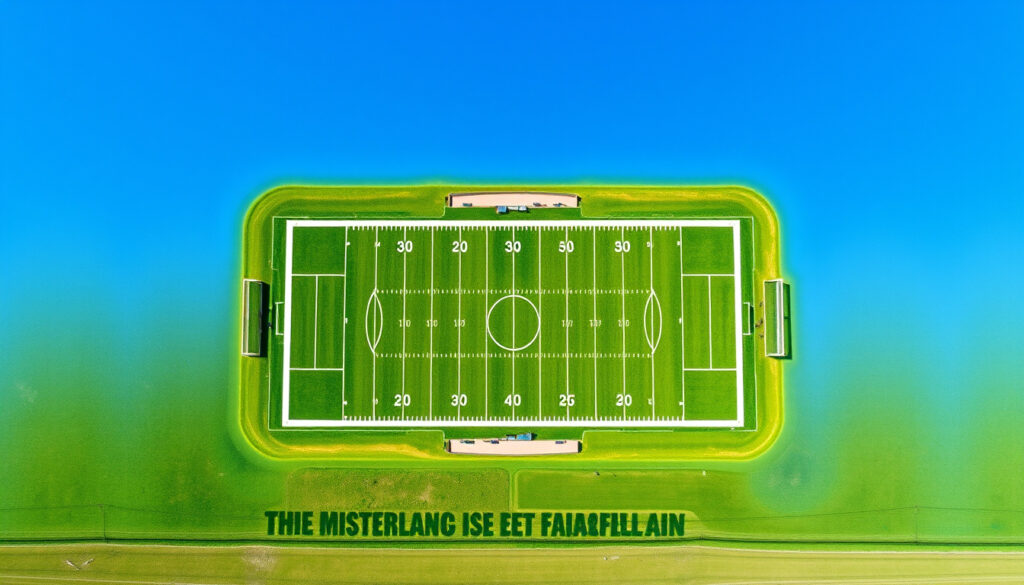
A square acre has sides of about 208.7 feet each, but thinking of it as a perfect square is rarely how land actually gets measured. The most useful visualization comes from an unexpected source: American football. Washington Grown, an agricultural publication, notes that “if you can picture a football field, that’s pretty close to an acre in size.” The key is knowing exactly which parts of the field to count.
“If you can picture a football field, that’s pretty close to an acre in size.”
— Washington Grown, agricultural publication
Football field comparisons
Mapscaping, which maintains area conversion tools, provides the precise math. An NFL football field measured from back of end zone to back of end zone spans 360 feet long by 160 feet wide, totaling 57,600 square feet or 1.32 acres. Without end zones, the playing field proper is 300 by 160 feet (48,000 sq ft / 1.10 acres). Since an acre is 43,560 square feet, it lands at roughly 91% of a field excluding end zones, or about 76% when you include them.
“One acre equals approximately 0.76 NFL football fields (using the full field including end zones).”
— Mapscaping, area conversion calculator
Real-world images and landmarks
Beyond football, a helpful way to internalize the scale: 10 acres equals approximately 7.6 NFL football fields, while 5 acres covers about 3.8 fields. Central Park in New York City spans 843 acres—roughly 640 football fields. For suburban context, a typical lot of 0.25 acres is just under 0.19 football fields. Mapscaping’s calculations put a city block at around 2.5 acres, or nearly two football fields.
Most people overestimate an acre’s size. When you mentally compress a football field to exclude the end zones, the remaining playing surface is almost exactly one acre.
How many football fields are in 1 acre?
The answer depends on which football field definition you use, and that’s where confusion creeps in. Turf Tank, a sports field measurement specialist, breaks down the official NFL dimensions: 120 yards long (from back of end zone to back of end zone) and 53.3 yards wide. Converting to meters gives 109.7 meters by 48.8 meters. These are the exact specifications teams work with when installing turf or marking hash marks.
American football field size
The key numbers for comparison: a full NFL field including both 30-foot end zones covers 57,600 square feet, which equals 1.32 acres. That means one acre is roughly 0.76 of a full NFL field. But many comparisons use the playing field alone—300 by 160 feet, or 48,000 square feet. Fact Monster confirms that an acre is about 91% of a field excluding end zones. The distinction matters: depending on which standard you reference, an acre is either slightly more or less than one football field.
UK football pitch equivalents
UK pitches vary more widely than American football fields, which follow standardized NFL rules. The Scottish and Irish acres themselves differ from the US standard—Washington Grown reports that a Scottish acre is 1.27 times larger than a US acre, while an Irish acre is 1.6 times larger. If you’re comparing land sizes across UK/US contexts, you can’t assume a direct one-to-one translation.
For property buyers in the UK, a stated “acre” may legally mean a Scottish or Irish acre—meaning you could be getting significantly more or less land than expected from American real estate conventions.
The implication is that international land transactions require verification of which regional acre standard applies, not just assuming a universal definition.
What size is 1 acre?
The official definition traces back to medieval land surveyors: one acre was the area a yoke of oxen could plow in a day. The modern US survey acre is precisely 43,560 square feet—a number that sounds arbitrary until you understand its origins in chains and furlongs. One chain (66 feet) by one furlong (660 feet) equals exactly one acre, and there are 640 acres in a square mile.
Imperial dimensions
The 66 by 660 feet rectangle is the traditional shape, but land rarely parcels out so neatly. More commonly, you’ll encounter lots described in combinations like “100 by 200 feet” or “150 by 290 feet.” The math stays simple: multiply length by width in feet, then divide by 43,560. A 100 by 200 foot lot is exactly 20,000 square feet—about 0.46 acres, or just under half. Conversely, if you know a lot is half an acre, it’s roughly 21,780 square feet, which might shape as 100 by 218 feet or 150 by 145 feet.
Square footage breakdown
Prime Land Buyers, a real estate visual reference, notes that an acre also equals 4,840 square yards. The square root of 43,560 (for a perfect square shape) is approximately 208.7 feet per side. This gives property owners a quick mental check: if your rectangular lot can fit inside a roughly 209 by 209 foot square, you’re working with about one acre.
Irregularly shaped lots often measure as “one acre” by total area even if neither dimension approaches 208 feet. A long narrow strip—say, 50 feet wide by 871 feet long—also equals one acre despite looking nothing like a square.
What this means is that total area tells only part of the story—a one-acre parcel can take wildly different physical shapes depending on how it’s been subdivided.
How big is an acre in meters?
Metric conversions matter for international property deals, construction projects, or anyone more comfortable thinking in meters. Prime Land Buyers provides the direct conversion: one acre equals 4,047 square meters. The more precise figure from official conversion tables is 4,046.86 square meters, with 0.404686 hectares as the hectare equivalent.
Square meters
For a square approximation: if an acre were a perfect square in metric terms, each side would be approximately 63.6 meters (since 63.6 × 63.6 ≈ 4,046). This 63m × 63m mental picture works well for visualizing residential lots. A hectare (10,000 square meters) equals approximately 2.47 acres, making it a useful comparison for larger properties—roughly two and a half acres is one hectare.
Linear dimensions
Mapscaping’s data helps translate football field comparisons to metric: one NFL field is approximately 5,351 square meters. That means one acre (4,047 sq m) is about 76% of a full NFL field in metric terms as well. For custom calculations: a 100 meter × 100 meter plot equals exactly 10,000 square meters, or 2.47 acres. A 50m × 80m lot (4,000 sq m) is just under one acre.
For international buyers, the 4,047 sq m figure provides a reliable baseline when comparing listings across measurement systems.
How big is an acre in feet?
The feet measurement is where the acre feels most tangible for American audiences. Washington Grown confirms the standard: one acre equals exactly 43,560 square feet. This number stays fixed regardless of shape—the same 43,560 square feet could be a 66 × 660 foot strip, a 100 × 435.6 foot rectangle, or a 208.7 × 208.7 foot square.
Exact square feet
For practical lot sizing, common residential dimensions cluster around recognizable figures: a 100 by 200 foot lot gives you 20,000 square feet (0.46 acres—almost exactly half). A 125 by 350 foot lot also hits around 0.99 acres. Fact Monster’s comparison confirms the football field tie: a field without end zones is 48,000 square feet, making an acre roughly 91% of that familiar shape.
Common shapes like 100×200
Real estate listings frequently round to simple dimensions. Understanding why helps: a “100 by 200” lot is easy to visualize and calculate, and it lands at almost exactly half an acre. The slight difference (20,000 sq ft actual vs. 21,780 sq ft for half an acre) rarely matters for rough property comparisons. For precision, always convert any rectangular dimension back to square footage before comparing to the 43,560 sq ft baseline.
For buyers comparing lot sizes, the “100 by 200” shorthand is useful but incomplete—a deeper lot at 80 by 270 feet (21,600 sq ft) actually contains more area than a shallower 100 by 200 foot lot, even though the “100 by 200” sounds larger.
The pattern shows that perimeter-based descriptions can mislead buyers who don’t convert back to square footage for direct comparison.
Most people shopping for property encounter acres before they understand how they translate to football fields, meters, or city blocks. The good news: once you anchor an acre to a familiar reference—like “slightly smaller than a football field without end zones”—the abstraction disappears. The confirmed figures (43,560 sq ft, 4,047 sq m, 0.91 football fields) become tools rather than trivia.
Related reading: Property for Sale Leitrim · Where Is Epstein Island
While visuals like football fields help, knowing an acre spans exactly 43,560 square feet in an acre clarifies property scales for buyers and farmers.
Frequently asked questions
How many acres is 100m by 100m?
A 100 meter by 100 meter plot equals 10,000 square meters, which converts to approximately 2.47 acres. This is a common reference size for land parcels in international contexts.
Is 100 by 200 half an acre?
A 100 by 200 foot lot is exactly 20,000 square feet. Half an acre would be 21,780 square feet, so a 100 × 200 foot lot is slightly under half an acre at about 0.46 acres.
What does 1 acre look like in the UK?
In the UK, an acre follows the same 43,560 square foot definition as the US standard. However, Scottish acres are 1.27 times larger and Irish acres are 1.6 times larger, so regional context matters in UK property transactions.
How big is an acre in hectares?
One acre equals 0.4047 hectares. For reference, a hectare is 10,000 square meters, making an acre slightly less than half a hectare.
How big is an acre in miles?
An acre is 1/640 of a square mile. You would need 640 acres to fill one square mile of area.
How big is an acre for a house?
A typical suburban house sits on a lot between 0.2 and 0.5 acres. A quarter-acre lot (0.25 acres, roughly 10,890 sq ft) accommodates a modest single-family home with driveway and small yard, while a half-acre lot offers noticeably more outdoor space.
What’s the best way to visualize an acre?
Picture a standard American football field without the two end zones. The remaining playing surface (300 × 160 feet, 48,000 sq ft) is about 91% of an acre. An acre is just slightly smaller than that familiar shape.
More related posts
 Where to travel in summer? Best destinations 2026
 Dyson V Hand Dryer: Specs, Worth It, Problems & Guide
 Cast of Friday Night Dinner: Deaths, Actors & Show Facts
 Loreto on the Green: Fee , Hi tory, Admi ion Guide
 H&M Discount Code – Verified Deals April 2026
 Grated cheese recall listeria: brands, symptoms & treatment
 Connolly Hospital Visiting Hours – Times, Rules and Contacts
 How to Make Overnight Oats: Recipe, Health & Mistakes
