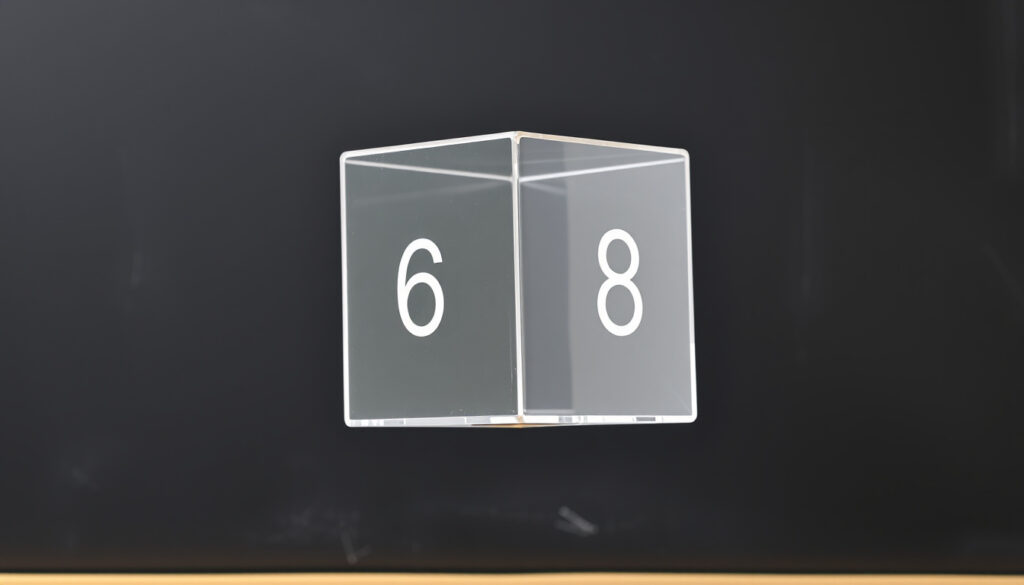
How Many Faces Does a Cube Have? 6 Faces, 8 Vertices
If you’re staring at a closed cardboard box or a child’s building block, you’re looking at one of the most basic questions in geometry: how many faces does a cube have? The answer is exactly six, but the confusion starts when you move to shapes like spheres and cylinders — walk through the exact counts for a cube, cuboid, sphere, and cylinder so you’ll never mix them up again.
Faces of a cube: 6 · Vertices of a cube: 8 · Edges of a cube: 12 · Faces of a cuboid: 6 · Faces of a sphere (flat): 0 · Faces of a cylinder (flat): 2
Quick snapshot
- A cube has 6 square faces, 8 vertices, and 12 edges (Super Teacher Worksheets (K-5 teaching resources))
- A cuboid also has 6 faces, 8 vertices, and 12 edges (Math Worksheets 4 Kids (K-8 math resource))
- Whether a sphere’s curved surface counts as a “face” depends on the definition (Common Core Sheets (Common Core–aligned practice))
- A cylinder is sometimes counted as having 2 faces (flat only) or 3 (including curved) (Noodle Kidz (educational YouTube channel))
- Worksheet-style resources on faces, edges, and vertices have been used since early elementary grades (K5 Learning (math worksheet publisher))
- Students typically move from counting faces of simple solids to more complex shapes like prisms and pyramids (Tes (educator resource platform))
The table below compares the flat faces, curved surfaces, edges, and vertices for five common 3D shapes.
| Shape | Flat faces | Curved surfaces | Edges | Vertices |
|---|---|---|---|---|
| Cube | 6 squares | 0 | 12 | 8 |
| Cuboid | 6 rectangles | 0 | 12 | 8 |
| Sphere | 0 | 1 | 0 | 0 |
| Cylinder | 2 circles | 1 | 2 (circular) | 0 |
| Rectangular prism | 6 rectangles | 0 | 12 | 8 |
The pattern is clear: cubes and cuboids share the same structure but differ in face dimensions, while spheres and cylinders break the mold with curved surfaces.
How many faces does a cube have?
A cube has exactly 6 flat faces, each of which is a square. This property is consistent across all teaching materials, from Common Core Sheets (shape worksheets) to Super Teacher Worksheets. The cube is a regular hexahedron — a three-dimensional shape where all faces are congruent squares.
What are the faces of a cube?
- Each face is a square of equal side length (Super Teacher Worksheets)
- The six faces meet at the edges; each face is adjacent to four others
- Common examples: dice, sugar cubes, Rubik’s Cubes
How many vertices does a cube have?
A cube has 8 vertices — the corners where three faces meet. Teaching worksheets from Common Core Sheets confirm this count for all rectangular prisms.
How many edges does a cube have?
A cube has 12 edges — the line segments where two faces meet. Every edge is the same length. This is a standard fact documented by Tes (educator resource platform).
How many corners does a cube have?
The term “corners” is often used interchangeably with vertices. A cube has 8 corners, as noted in elementary worksheets from Math Worksheets 4 Kids.
This solid foundation makes the cube an ideal starting point for teaching 3D shape properties.
Is each face of a cube a square?
Yes, every face of a cube is a square. In fact, the cube is the only regular hexahedron: all six faces are congruent squares. This definition is used by K5 Learning (math curriculum provider) and Super Teacher Worksheets.
What shape are the faces of a cube?
- Square — all sides equal length
- Each square face has an area of side² (Common Core Sheets)
Why are cube faces squares?
Because a cube is defined as a regular polyhedron with square faces. This property sets it apart from a cuboid, which can have rectangular faces of different dimensions.
For any student who can identify a square, the cube is the friendliest 3D shape to start with. All faces are identical, so counting them is just a matter of checking each of the six sides.
This uniformity makes the cube a reliable example for teaching face counting.
How many faces does a cuboid have?
A cuboid also has 6 faces, but they are rectangular rather than square. It shares the same number of vertices (8) and edges (12) as a cube. Math Worksheets 4 Kids and Tes both teach this comparison.
How many vertices and edges does a cuboid have?
- 8 vertices
- 12 edges
- Faces may be different sizes (unlike a cube)
What is the difference between a cube and a cuboid?
A cube is a special cuboid where all faces are squares of the same size. In a general cuboid, opposite faces are equal rectangles but adjacent faces can have different dimensions. This distinction is explained in worksheets from Math Worksheets 4 Kids.
Teachers can use this contrast to highlight the concept of rectangular versus square faces.
How many faces does a sphere have?
According to standard polyhedron definitions, a sphere has 0 flat faces. Instead, it has one curved surface with no edges or vertices. Common Core Sheets reinforces this: “a sphere has one curved face, zero flat surfaces, zero edges, zero vertices.”
Does a sphere have 0 or 1 faces?
- In polyhedron definitions (elementary geometry): 0 flat faces
- In broader usage that counts curved surfaces: 1 face
- Most K-5 resources, including Common Core Sheets, teach 0 flat faces
Which shape has 0 faces?
A sphere is the most common shape taught as having 0 flat faces. This also applies to any shape with exclusively curved surfaces.
Why is a sphere considered to have 0 flat faces?
Because a “face” in early geometry refers to a flat surface. A sphere’s surface is uniformly curved, so it fails the flatness condition.
When students encounter a sphere for the first time, they often ask “does a ball have a face?” The answer depends on the definition — but in standard school curricula, a sphere has 0 flat faces and 0 edges. This is a common sticking point in second-grade worksheets.
Clarifying this distinction early prevents confusion when moving to cylinders.
Does a cylinder have 2 or 3 faces?
A cylinder has 2 flat circular faces (top and bottom) and 1 curved surface. Counting it as 2 or 3 faces depends on whether the curved surface is considered a “face.” Super Teacher Worksheets states: “a cylinder has one curved face, two flat surfaces, zero edges, zero vertices.” Many textbooks, however, count 2 flat faces and treat the curved part separately.
How many faces does a cylinder have?
- Common elementary answer: 2 faces (only flat)
- Inclusive answer: 3 faces (including curved surface)
- Common Core Sheets leave room for both interpretations
What are the faces of a cylinder?
The two flat faces are circles of equal radius. The curved surface is a rectangle when unrolled.
Why some sources count 2 faces and others 3?
Because the definition of “face” is ambiguous. Strict polyhedron definitions require flat surfaces, while more general geometric descriptions include curved surfaces.
Teachers face a choice: follow the strict flat-face definition (cylinder has 2 faces) or the inclusive one (3 faces). The answer matters for worksheet accuracy—especially when comparing cylinders to cubes and spheres.
This table shows how the face count changes depending on whether curved surfaces are included.
| Shape | Flat faces | Curved surfaces | Total faces (if curved counted) |
|---|---|---|---|
| Cube | 6 | 0 | 6 |
| Cuboid | 6 | 0 | 6 |
| Sphere | 0 | 1 | 1 |
| Cylinder | 2 | 1 | 3 |
The trade-off is clear: if you count only flat faces, cylinder matches the cube’s pattern? No — cylinder then has 2 vs cube’s 6. If you include curved, cylinder jumps to 3. Consistency in definition is crucial for classroom worksheets.
The pattern shows that educators must decide on a single definition to avoid student confusion.
Cube specifications at a glance
The following table summarizes the specifications of a cube with sources.
| Property | Value | Source |
|---|---|---|
| Number of faces | 6 | K5 Learning |
| Shape of each face | Square | Super Teacher Worksheets |
| Number of vertices | 8 | Common Core Sheets |
| Number of edges | 12 | Tes |
| All edges equal length? | Yes | Noodle Kidz |
| Regular hexahedron? | Yes | Math Worksheets 4 Kids |
What’s confirmed and what’s still unclear
Confirmed facts
- A cube has exactly 6 square faces. (Super Teacher Worksheets)
- Each face of a cube is a square. (Common Core Sheets)
- A cuboid has 6 rectangular faces. (Math Worksheets 4 Kids)
- A sphere has 0 flat faces and 0 edges. (K5 Learning)
- A cylinder has 2 flat circular faces. (Tes)
What’s unclear
- Whether a curved surface is considered a “face” for spheres and cylinders.
- Whether a cylinder has 2 faces (flat only) or 3 (including curved).
- Whether a cylinder’s circular edges count as edges in all definitions.
Expert perspectives
A cube has 6 square faces, 8 vertices, and 12 edges.
— Cuemath (math education platform)
A cube (hexahedron) is formed by placing three squares at each of eight vertices. A cube has: 6 square faces, 8 vertices, 12 edges.
— CK12 Foundation (educational resource)
A cuboid has six faces, 12 edges, and 8 vertices.
— Noodle Kidz (educational YouTube channel)
Why these definitions matter
For a second-grade teacher preparing a geometry unit, the choice of definition determines whether a sphere gets a “0” or a “1” on the worksheet. That single number can confuse a seven-year-old who sees a ball and thinks it has one continuous surface. The implication: educators must state upfront whether they count curved surfaces as faces. For students who move on to volume and surface area, understanding that a cube has exactly 6 square faces is the foundation for calculating its total surface area (6s²). For the parent helping with homework, the rule is simple: a cube has 6 faces, all squares — and that never changes.
Frequently asked questions
How many faces does a rectangular prism have?
A rectangular prism (including a cuboid) has 6 rectangular faces.
How many faces does a triangular prism have?
A triangular prism has 5 faces: 2 triangular faces and 3 rectangular faces, with 6 vertices and 9 edges.
How many faces does a pyramid have?
A square pyramid has 5 faces: 4 triangular faces and 1 square base. A triangular pyramid (tetrahedron) has 4 faces.
How many faces does a cone have?
A cone has 1 flat circular face (the base) and 1 curved surface, giving it either 1 face (flat-only) or 2 faces (including curved).
How many faces does a hemisphere have?
A hemisphere has 1 flat circular face and 1 curved surface — similar to a cone but with a half-sphere top.
What is the difference between a face and a side in 3D shapes?
A face is a flat surface of a solid; a side can refer to both faces and edges. In polyhedron contexts, “side” is ambiguous, so educators prefer “face” for flat surfaces.
Are all cube faces congruent?
Yes, all six faces of a cube are congruent squares — equal in size and shape.
For a parent choosing between a cube and a cuboid building set, the difference is clear: cube blocks stack identically on any face, while cuboid blocks only match on opposite faces. For an educator compiling next week’s worksheet, the consistent answer remains 6 flat faces for cubes and cuboids, 0 for spheres, and 2 for cylinders — unless you decide to count the curve.
Related reading: How Many Edges Does a Cube Have? · What Is a Regular Polyhedron? · 3D Shapes Worksheets for Grade 2
More related posts
 Let It Be Lyrics: Meaning, Origin & Mother Mary Story
 Wie Organisiert Man Die Küche – Practical Tips and Steps
 The Lake Hotel Killarney: Reviews, Prices, Spa & Wedding Guide
 Eye Test Near Me: Ireland Free Tests & Costs
 Malahide Castle Concert Capacity: 20,000 – Seating, Times & Layout
 Women’s World Cup Rugby – Full 2025 Tournament Guide
