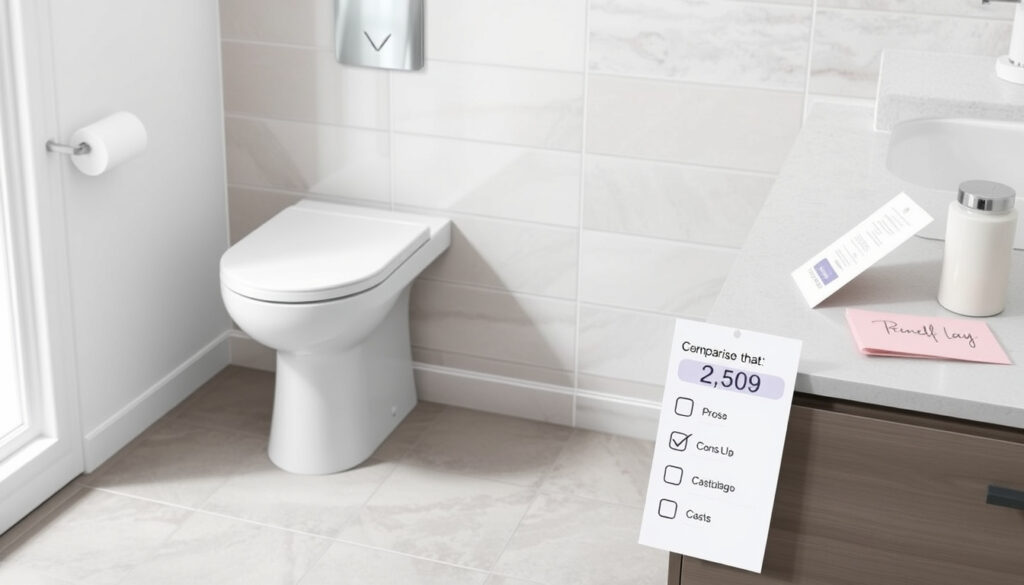
Back to Wall Toilet Guide: Pros, Cons, Costs & Comparison
You’ve seen them in glossy bathroom catalogues – sleek toilets that sit flush against the wall with no unsightly pipes or bulky cisterns. They look modern, clean, and almost too good to be true. But before you commit to a back to wall toilet, there’s a practical side to consider: does the hidden design cost more to install and maintain than a standard close-coupled toilet? This guide weighs the real trade-offs so you can decide whether that minimalist look is worth the extra effort.
Average price (basic model): €250 – €600 · Typical depth: 75 – 85 cm · Common features: Rimless pan, soft-close seat, dual flush
Quick snapshot
- Cistern concealed behind pan or furniture unit (MyHomeware (bathroom product guide))
- Pan sits flush against the wall with no exposed pipework (Renovate with Reno (plumbing advice))
- Widely available from bathroom retailers (Durovin Bathrooms (UK bathroom specialist))
- Whether rimless back to wall pans are significantly more hygienic than close-coupled is still debated (Ultra Bathroom (bathroom retailer insights))
- Long-term durability compared to standard toilets lacks large-scale comparative data (Grand Designs Magazine (design & architecture authority))
- Installation typically requires a professional plumber and can take 1–2 days due to concealed pipework and frame fitting (Grand Designs Magazine)
- Expect to pay €250–€800 for the unit alone, plus installation labour that can add €200–€500 (Consumer Reports (independent consumer advocacy))
- Check compatibility with your existing waste pipe layout (Renovate with Reno)
Six key facts at a glance: the main trade-offs between back to wall and close-coupled toilets.
| Attribute | Back to wall toilet | Close-coupled toilet |
|---|---|---|
| Pan type | Back to wall (concealed cistern) | Visible cistern attached to bowl |
| Cistern | Concealed behind pan or furniture | Visible, attached to bowl |
| Installation | Requires frame or furniture unit; professional recommended | Simpler DIY possible; less structural work |
| Cleaning | Easier due to smooth lines, no crevices | Visible cistern and pipes collect dust |
| Price (unit) | €150 – €400 (pan alone); €400 – €800 (full set with frame) | €100 – €300 (complete suite) |
| Maintenance access | Harder – cistern hidden behind wall/unit | Easy – lift lid to access cistern |
What is a back-to-wall toilet?
A back to wall toilet hides the cistern inside a wall cavity or a furniture unit, leaving only the pan and a flush plate visible on the wall. The pan sits flush against the wall, eliminating exposed pipework and creating a clean, modern look (Renovate with Reno (plumbing installation guide)). This design is often described as a compromise between the minimalist style of a wall-hung toilet and the simpler floor-standing installation of a standard close-coupled toilet (Renovate with Reno).
How does a back to wall toilet differ from a close-coupled toilet?
- Close-coupled: the cistern sits directly on the bowl in one visible unit. It’s the most common type found in homes today (Ultra Bathroom (bathroom product hub)).
- Back to wall: the cistern is concealed. The pan is floor-standing but pushed against the wall.
- Look: back to wall hides cistern and pipework; close-coupled shows them.
What are the key components of a back to wall toilet?
- A concealed cistern (often a slimline unit that fits inside a stud wall or furniture cabinet)
- A floor-standing pan that is flat at the back to sit against the wall
- A flush plate mounted on the wall or furniture front
- Concealed pipework (waste and water supply run inside the wall or unit)
You gain a seamless bathroom aesthetic but trade easy access to the cistern for later repairs. If the flush mechanism fails, you’ll need to remove the flush plate or open the wall unit – not a 5-minute fix like on a close-coupled toilet.
The implication: back to wall toilets appeal most to homeowners who prioritise clean lines over maintenance convenience. For renters or those who prefer simple DIY fixes, a close-coupled model may be more practical.
Are back to wall toilets a good idea?
For many buyers, the answer depends on how much weight you give to aesthetics versus long-term cost and convenience. Yes, if you want a sleek, minimalist bathroom and can handle a higher upfront cost. No, if you’re on a tight budget or don’t want to call a plumber every time the cistern needs a tweak.
What are the pros of a back to wall toilet?
- Cleaner look – no visible cistern or pipework (Ultra Bathroom)
- Space-saving – can free up visual floor area, though it still uses floor space
- Easier to clean around the pan – no crevices or pipes behind (Grand Designs Magazine (UK design & architecture))
- Often paired with rimless pans that reduce areas where bacteria can hide
Who should consider a back to wall toilet?
- Homeowners renovating a bathroom with a modern or minimalist design brief
- Anyone with a dedicated bathroom cabinet or stud wall that can conceal the cistern
- Buyers willing to spend €150–€400 more than a standard toilet for the look
What this means: back to wall toilets are a design-led choice, not a budget one. They excel at aesthetics and ease of floor cleaning but require more planning and money up front.
What are the disadvantages of a back to wall toilet?
The sleek facade hides a few headaches that buyers should know about before committing. Here are the main drawbacks, backed by installer insights and consumer reports.
Is installation more expensive?
- Yes. A back to wall toilet costs more than a close-coupled model (unit price from €150 to €400 for the pan alone, plus €250–€400 for the concealed cistern and frame). Installation labour adds €200–€500 because the pipework requires careful routing and the frame must be secured (Consumer Reports (independent testing and advice)).
- Total cost can reach €800–€1,300 compared to €300–€600 for a basic close-coupled suite.
What about maintenance and repair access?
- Accessing the cistern means removing the flush plate or a section of the furniture unit. Not a job for a quick DIY (Grand Designs Magazine).
- If the cistern leaks inside the wall cavity, water damage can go unnoticed until it’s serious. Proper waterproofing during installation is critical.
Are there any hygiene issues?
- Back to wall toilets with rimless pans are promoted as more hygienic because there’s no rim where bacteria can gather. But independent studies comparing rimless vs standard pans show mixed results (Ultra Bathroom).
- Flushing can still aerosolise water droplets; closing the lid before flushing reduces contamination regardless of toilet type.
The biggest risk isn’t the toilet itself – it’s the installation. If the concealed cistern or pipework isn’t fitted correctly, you may face repairs that require breaking into a wall or cabinet. A specialist installer with back-to-wall experience is non-negotiable.
The pattern: higher initial cost and harder maintenance access are the two consistent complaints. For owners who value convenience over silhouette, these trade-offs can be deal-breakers.
What is the difference between a back to wall toilet and a standard toilet?
Three design categories cover most bathroom toilets: close-coupled (standard), back to wall, and wall-hung. Here’s a direct comparison of the key factors.
Three toilet types, one big difference: the visibility of the cistern and the complexity of the install.
| Feature | Close-coupled (standard) | Back to wall | Wall-hung |
|---|---|---|---|
| Cistern position | Visible, attached to bowl | Concealed behind pan or furniture | Hidden inside wall frame |
| Floor contact | Pan on floor, cistern above | Pan on floor, cistern hidden | No floor contact (floating) |
| Installation difficulty | Low – DIY possible (Renovate with Reno) | Medium – requires frame/furniture (Grand Designs Magazine) | High – structural wall work (Consumer Reports) |
| Cleaning under/toilet | Harder – pipes and cistern in the way | Easier on floor, pan back is flush | Easiest – no floor obstacles |
| Typical cost (unit + install) | €300 – €600 | €500 – €1,100 | €700 – €1,500 |
Which is easier to install?
- Close-coupled is the easiest. Bolts directly to floor, cistern attaches to bowl, standard waste connector. A competent DIYer can do it in a day (Renovate with Reno).
- Back to wall requires building a frame or buying a furniture unit to hide the cistern. The waste pipe often needs a 90-degree turn. Professional fitting strongly recommended.
- Wall-hung is the hardest: the tank and frame go inside the wall, meaning you open up the wall and reroute waste lines. Cost can exceed US$1,000 for installation (Consumer Reports).
The trade-off: with every step up in aesthetic sleekness, you sacrifice simplicity and add cost. Back to wall sits in the middle – cleaner than close-coupled, but not as dramatic as wall-hung, and with a moderate installation challenge.
How far does fecal matter travel when you flush?
Hygiene concerns often drive buyers towards rimless back-to-wall pans. Here’s what the research says about flush spray and how toilet design affects it.
Does a back to wall toilet reduce splashing?
- Studies show that flushing a toilet can aerosolize fecal matter up to 6 feet (about 1.8 metres) (Consumer Reports citing public health research).
- The type of toilet pan (rimless vs rimmed) may influence the direction and amount of spray, but the effect is small compared to the simple act of closing the lid before flushing.
What is the role of rimless design in hygiene?
- Rimless pans remove the inner rim where bacteria can accumulate, making them easier to clean thoroughly (Ultra Bathroom).
- Many back to wall toilets come with rimless pans as standard, but this is not unique to the design – rimless close-coupled models also exist.
What to watch: the hygiene advantage of a rimless pan is real for cleaning, but not a magic bullet against aerosolisation. The lid remains the cheapest and most effective guard.
Specification table: typical back to wall toilet dimensions and features
Nine spec points, one key takeaway: back to wall toilets are slightly deeper than standard close-coupled because the pan extends forward to align with the wall.
| Specification | Typical value | Notes |
|---|---|---|
| Pan width | 36 – 40 cm | Standard for most models |
| Pan depth (back of pan to front) | 55 – 65 cm | Deeper than close-coupled (about 5–10 cm) because pan meets wall at the back |
| Pan height | 40 – 45 cm | Comfort height options available at 43–45 cm |
| Overall depth (pan + projection) | 75 – 85 cm | From wall to front of bowl |
| Concealed cistern capacity | 6 – 9 litres | Dual flush (3/6 L or 4.5/9 L) |
| Flush plate size | 20 × 15 cm typical | Available in various finishes |
| Waste outlet | Horizontal or vertical | Check compatibility with existing soil pipe |
| Weight capacity | 300 – 400 kg | Floor-standing frame |
| Material | Vitreous china | Standard for all toilet pans |
The 75–85 cm overall depth is about 10 cm more than a typical close-coupled toilet. In a small bathroom, that extra 10 cm can feel like a squeeze. Measure your space carefully before buying – a back to wall toilet may not fit the same footprint as your old toilet.
Pros and cons of back to wall toilets
Upsides
- Clean, minimalist appearance – no exposed cistern or pipework
- Easier to clean around the pan – smooth surfaces, no crevices
- Often includes rimless pan for better hygiene
- Space-saving in visual terms (less clutter)
- Can be combined with a vanity unit above the cistern for extra storage
Downsides
- Higher purchase cost (€150–€400 more than close-coupled)
- More expensive installation (€200–€500 extra labour)
- Harder maintenance access – cistern hidden
- Risk of water damage if concealed pipework leaks
- Requires professional installation – not a DIY job for most
How to install a back to wall toilet: 5 steps
While professional installation is strongly recommended, understanding the process helps you plan the bathroom layout and budget. These steps come from installer guides and plumbing resources.
- Prepare the wall and waste connection. Install a supporting frame or furniture cabinet that can hold the concealed cistern. The waste pipe must exit the wall or floor at the correct height (usually 18–20 cm above floor level) (Renovate with Reno).
- Fit the concealed cistern. Secure the cistern inside the frame or cabinet. Connect the water supply and set the flush volume (dual flush 3/6 L is standard).
- Attach the flush plate. Mount the plate on the wall or furniture front, ensuring the actuator connects properly to the cistern mechanism.
- Position and fix the pan. Push the pan against the wall, align it with the waste outlet, and bolt it to the floor. The pan’s back should sit flush to the wall with no gap.
- Connect waste and water. Use a pan connector to link the pan outlet to the waste pipe. Turn on the water and test for leaks. Seal around the pan base with silicone.
The pattern: the extra steps are all about hiding the mechanics. If you’re comfortable with basic plumbing, you can manage steps 1–3, but step 4 and 5 are where mistakes happen. A small misalignment can cause a permanent gap between pan and wall.
What we know – and what’s still unclear
Confirmed facts
- Back to wall toilets are widely available from bathroom retailers (Durovin Bathrooms).
- They conceal the cistern and pipework, providing a cleaner look (MyHomeware).
- Installation is more complex and costly than a standard toilet (Grand Designs Magazine).
What’s still unclear
- Whether rimless back to wall pans are significantly more hygienic than close-coupled rimmed pans lacks consensus (Ultra Bathroom).
- Long-term durability data comparing back to wall to close-coupled toilets is not widely published – most comparisons come from retailer descriptions, not independent testing.
Expert and industry perspectives
“Back to wall toilets are ideal for creating a modern and clean look in your bathroom.”
“Back-to-wall toilets are harder to install than ordinary close-coupled toilets because the cistern and pipework are hidden behind a wall or unit.”
Grand Designs Magazine (UK design and architecture publication)
Summary: the real choice
Back to wall toilets deliver on their promise: a sleek, modern bathroom without the clutter of a visible cistern. But that clean facade comes at a cost – not just in euros, but in installation complexity and future maintenance access. For homeowners renovating with a minimalist vision and a budget that allows for professional fitting, the trade-off is usually worth it. For anyone who values simplicity, easy repairs, and a lower upfront spend, a close-coupled toilet remains the smarter choice.
For the Irish bathroom buyer planning a renovation, the decision is clear: hire a trusted plumber who has installed back to wall units before, or stick with a close-coupled suite that you can fix yourself on a Sunday afternoon.
Är nyfiken på om den snygga designen är värd merkostnaden? Vår guide till back to wall-toaletter går igenom alla för- och nackdelar.
Frequently asked questions
How much does a back to wall toilet cost?
A basic back to wall pan costs approximately €150–€400, while a full set including concealed cistern and frame ranges from €400 to €800. Installation adds €200–€500, bringing the total to €600–€1,300 (Consumer Reports).
What are the standard dimensions of a back to wall toilet?
Typical dimensions: pan width 36–40 cm, pan depth 55–65 cm, overall depth from wall 75–85 cm, height 40–45 cm. Always measure your bathroom space before purchasing.
Can I install a back to wall toilet without a frame?
No, a back to wall toilet requires a concealed cistern support frame or a furniture cabinet to hold the cistern and pipework. The pan itself sits on the floor, but the cistern must be housed behind the wall or inside a unit (Grand Designs Magazine).
Do back to wall toilets need a special waste pipe?
Not necessarily – but the waste pipe often requires a 90-degree bend because the pan outlet is horizontal and meets the soil pipe behind the wall. Standard 110 mm (4 in) pipework works, but the routing is trickier than a close-coupled toilet.
What is the best back to wall toilet for small bathrooms?
Look for compact models with overall depth under 70 cm and a shallow projection. Brands like Villeroy & Boch, Duravit, and Grohe offer space-saving back to wall suites (Durovin Bathrooms).
Are back to wall toilets more hygienic than standard toilets?
They can be, because the smooth surfaces and rimless pan designs make cleaning easier. However, standard toilets with rimless pans also exist. The hygiene advantage comes more from the rimless design than the back to wall configuration (Ultra Bathroom).
How do I maintain a back to wall toilet?
Regular cleaning of the pan and flush plate is the same as any toilet. For internal maintenance, access the cistern by removing the flush plate (which usually clips off). Keep a spare flush valve seal handy – it’s the most common part to fail. Schedule a yearly check of concealed connections for leaks.
Related reading:
- Dyson V Hand Dryer: Specs, Worth It, Problems & Guide
- Hotels in Galway City Centre: Best Areas, Prices & More
More related posts
 St Aidan’s Community School: Principal, Status, Key Facts
 The Beast from the East – 2018 Cold Wave Explained
 Flights to Japan from Dublin: 2025 Airlines, Prices & Tips
 Laser Eye Surgery Ireland: 2025 Cost, Worth, and Regret Rates
 Time Change October 2025: Do Clocks Go Back? Sleep Info
 How Many Tablespoons in a Cup? US, UK & Dry vs Liquid
 Summer of 69 Movie: Rating, Plot, Cast & Where to Stream (2025)
 Masters of the Air: Season 2, Accuracy, Worth Watching
