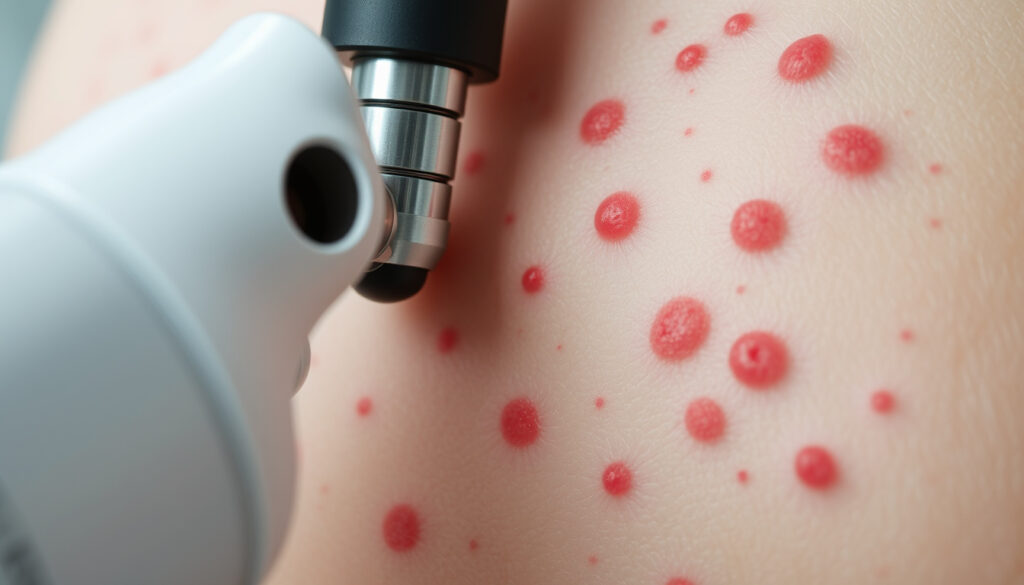
Cancer Red Spots on Skin: What They Look Like & When to Worry
You notice a new red spot on your skin, and your mind immediately jumps to the worst-case scenario. But not every red mark is a reason to panic — this guide walks you through what cancerous red spots actually look like, from skin cancers to leukemia-related petechiae, and helps you understand when a spot needs a doctor’s attention.
Types of skin cancer that may appear red: Basal cell carcinoma, squamous cell carcinoma, Kaposi sarcoma ·
Leukemia red spot appearance: Pinpoint reddish dots (petechiae) ·
SCC visual clues: Pink or red, scaly small bump or patch ·
BCC common form: Small, slow-growing, shiny pink or red lump or red scaly patch ·
Kaposi sarcoma lesions: Purple, red, or brown blotches or tumors
Quick snapshot
- Shiny pink or red lump (Roswell Park Comprehensive Cancer Center)
- Slow growing (Roswell Park Comprehensive Cancer Center)
- May have pearly edge (Roswell Park Comprehensive Cancer Center)
- Common on face, neck (Roswell Park Comprehensive Cancer Center)
- Red scaly patch or bump (Moffitt Cancer Center)
- May crust or bleed (Moffitt Cancer Center)
- Often on sun-exposed skin (Moffitt Cancer Center)
- Can be tender (Moffitt Cancer Center)
- Purple, red, or brown blotches (Roswell Park Comprehensive Cancer Center)
- Often in immunocompromised (Roswell Park Comprehensive Cancer Center)
- Can appear anywhere (Roswell Park Comprehensive Cancer Center)
- May be raised or flat (Roswell Park Comprehensive Cancer Center)
- Pinpoint red dots (Norton Children’s)
- Do not blanch (Norton Children’s)
- Occur in clusters (Norton Children’s)
- Often on legs, chest, back (Norton Children’s)
Five key facts that frame the landscape: most skin cancers are basal cell carcinomas, leukemia-related spots are a specific type called petechiae, sun exposure is a major risk factor for BCC and SCC, Kaposi sarcoma is closely tied to immune suppression, and only a biopsy can give a definitive diagnosis.
| Key Facts | Value |
|---|---|
| Most common skin cancer | Basal cell carcinoma (~80% of all skin cancers) (WebMD (health information platform)) |
| Leukemia red spot type | Petechiae (pinpoint non-blanching dots) (Roswell Park Comprehensive Cancer Center) |
| Sun exposure role | Major risk factor for BCC and SCC (Moffitt Cancer Center) |
| Kaposi sarcoma association | Often linked to HIV/AIDS or immunosuppression (Roswell Park Comprehensive Cancer Center) |
| Biopsy necessity | Only definitive way to diagnose skin cancer (Moffitt Cancer Center) |
What does a cancerous red spot look like?
What do leukaemia red spots look like?
- Pinpoint reddish dots, known as petechiae, caused by bleeding from broken capillaries under the skin (WebMD (health information platform)).
- They appear in clusters, are flat and painless, and do not fade when pressed (Moffitt Cancer Center).
- Leukemia-related petechiae often show up on the lower legs or ankles in children (Norton Children’s (pediatric healthcare system)).
Petechiae are not a disease themselves but a symptom — and they have many noncancerous triggers such as severe coughing or infection. But when they appear without a clear cause and persist, they warrant a blood test to rule out low platelet counts linked to leukemia.
What does basal cell carcinoma look like?
- Basal cell carcinoma (BCC) typically appears as a small, slow-growing, shiny pink or red lump, or a red scaly patch (Roswell Park Comprehensive Cancer Center).
- It may have a pearly or waxy edge and can bleed easily.
- Common on sun-exposed areas like the face, neck, and arms.
What does squamous cell carcinoma look like?
- Squamous cell carcinoma (SCC) often presents as a pink or red, scaly small bump or patch on sun-exposed skin (Moffitt Cancer Center).
- It may crust, bleed, or become tender.
- SCC is the second most common skin cancer and can grow over weeks to months.
What does Kaposi sarcoma look like?
- Kaposi sarcoma lesions appear as purple, red, or brown blotches or tumors on the skin (Roswell Park Comprehensive Cancer Center).
- They can be flat or raised and often appear in people with weakened immune systems.
- Lesions may develop anywhere on the body, including mucous membranes.
Can red spots mean cancer?
What is the biggest indicator of cancer?
- The most significant warning sign is a spot that is new, growing, changing, or not healing within three weeks (WebMD (health information platform)).
- For leukemia, the biggest indicator alongside petechiae is easy bruising or bleeding due to thrombocytopenia (Moffitt Cancer Center).
What other conditions cause red spots?
- Many red spots are benign: cherry angiomas, eczema, psoriasis, and contact dermatitis are common (WebMD (health information platform)).
- Petechiae can also arise from noncancerous causes like severe coughing, straining, infections, or trauma (WebMD).
The catch is that red spots from leukemia can closely resemble common inflammatory rashes like atopic dermatitis. The key difference is that petechiae do not blanch under pressure — a simple glass test can help distinguish them. If you press on the spot and it stays red, it is likely petechiae.
What are the 7 warning signs of skin cancer?
How does the ABCDE rule apply to red spots?
- Asymmetry: One half of the spot does not match the other.
- Border: Irregular, scalloped, or poorly defined edges.
- Color: Multiple colors or uneven distribution — red spots may be uniform, but any variegation raises suspicion.
- Diameter: Larger than 6 mm (about the size of a pencil eraser) (Moffitt Cancer Center).
- Evolving: Changing in size, shape, color, or symptoms (itching, bleeding).
What does an early stage skin cancer red spot look like?
- Early stage BCC can be a small red dot or patch that looks like a pimple that never heals (Roswell Park Comprehensive Cancer Center).
- Early SCC appears as a persistent red scaly patch, sometimes with a crusted surface.
- Early melanoma, while less often red, can present as a red spot in some subtypes (e.g., amelanotic melanoma).
When should I be worried about red spots on my skin?
When should I worry about red spots?
- Worry if the red spot is new, growing, bleeding, crusting, or not healing within three weeks (WebMD (health information platform)).
- Seek urgent care if petechiae appear suddenly along with fever, confusion, dizziness, difficulty breathing, or rapid spread (WebMD).
What makes a red spot suspicious?
- Red spots that are asymmetrical, have irregular borders, or show color variations are suspicious (Moffitt Cancer Center).
- Spots that do not blanch when pressed (petechiae) or that appear in clusters on the lower legs are specific flags.
- A red spot that changes over weeks — even slowly — warrants medical evaluation (Norton Children’s (pediatric healthcare system)).
How can I tell if a spot is cancerous?
How can you tell if a red spot is cancerous?
- Perform the ABCDE self-check and note any changes over time. Take a photo with a ruler for scale.
- Use the glass test for petechiae: press a clear glass against the spot. If it does not fade, it is likely petechiae (Moffitt Cancer Center).
- Any red spot that is new, growing, or not healing after three weeks should be seen by a dermatologist (Roswell Park Comprehensive Cancer Center).
What diagnostic tests are used?
- A complete blood count (CBC) can measure platelet count if leukemia is suspected (Roswell Park Comprehensive Cancer Center).
- Dermoscopy uses a magnifying lens with light to examine skin structures — it helps differentiate benign from suspicious spots.
- The only definitive test for skin cancer is a biopsy, where a small sample is sent to a pathologist (Moffitt Cancer Center).
A biopsy is the gold standard, but it is not always the first step. A dermatologist’s visual exam combined with dermoscopy can catch most concerning lesions early. For petechiae, a simple blood test can reveal low platelets — a common first sign of leukemia.
Confirmed facts vs. what’s unclear
- BCC and SCC can appear as red spots or patches (Roswell Park Comprehensive Cancer Center)
- Leukemia petechiae are red pinpoint dots (Norton Children’s)
- Kaposi sarcoma presents as red/purple blotches (Roswell Park Comprehensive Cancer Center)
- Non-healing or changing red spot requires medical evaluation (WebMD (health information platform))
- Exact proportion of skin cancers that initially appear red vs. other colors
- Whether a red spot is more likely to be cancerous based on location alone
- Whether the ABCDE rule applies equally to red-spot skin cancers
- Whether petechiae in children are more likely to be leukemia-related than in adults
“The abnormal cells of Kaposi sarcoma form purple, red, or brown blotches or tumors on the skin.”
American Cancer Society (national health organization)
“SCCs can look different. They can be a pink or red, scaly, small bump or patch.”
Cancer Research UK (leading cancer charity)
“Petechiae, or what many people know as ‘leukemia spots,’ are reddish, pinpoint-sized dots.”
Moffitt Cancer Center (NCI-designated cancer center)
The sum of the evidence: red spots on the skin can be a sign of cancer, but they are far more often benign. The danger lies not in every dot, but in the spot that persists, changes, or refuses to heal. For anyone who notices a new red spot that does not go away within three weeks, the sensible step is a visit to a dermatologist. For petechiae that appear suddenly with other symptoms like fever or bruising, a blood test can quickly rule out leukemia. For readers in the US, the choice is clear: see a board-certified dermatologist for any suspicious spot, or call your primary care doctor for petechiae — a delay of weeks could allow a treatable cancer to progress.
Frequently asked questions
Can a red spot be a sign of internal cancer?
Yes. Leukemia-related petechiae (red pinpoint dots) and Kaposi sarcoma lesions are red spots that can signal internal cancer. Skin cancers like BCC and SCC are external but can spread if untreated.
Is it possible to have skin cancer without a red spot?
Yes. Skin cancers can be brown, black, or skin-colored. Melanoma often appears as a dark mole, and some BCCs are flesh-colored or pearly white. Red spots are just one possible presentation.
How quickly do cancerous red spots grow?
Basal cell carcinomas grow slowly, over months to years. Squamous cell carcinomas can grow over weeks to months. Leukemia petechiae can appear suddenly, often over days.
Are red spots on skin painful?
Most cancerous red spots are painless. SCC may become tender. Petechiae are flat and painless. Pain is more common with inflammation or infection than cancer.
What does a non-cancerous red spot look like?
Benign red spots (cherry angiomas, insect bites, eczema) are often round, uniform in color, and may blanch. They typically do not grow or change over time. They may itch or come and go.
Can stress cause red spots on skin that mimic cancer?
Stress can trigger or worsen conditions like eczema, psoriasis, and hives, which cause red patches. It does not directly cause petechiae or cancerous lesions. However, stress-related rashes should be evaluated if persistent.
How often should I check my skin for red spots?
Monthly self-exams are recommended. Use a mirror to check all areas, including back, scalp, and between toes. Any new spot that lasts more than two weeks should be monitored or shown to a doctor.
Do red spots from leukemia appear all over the body?
Leukemia petechiae often appear on the lower legs and ankles, especially in children. In adults, they can appear on arms, legs, chest, and back. They tend to cluster in areas of pressure or trauma.
More related posts
 UEFA Champions League 2025: Format, Schedule & Bracket Guide
 Playa Feliz Gran Canaria – Reviews, Location and Pricing Guide
 Cork 5-Day Weather Forecast: Accuracy Guide
 Harry Potter LEGO Sets Guide: New, Rare & Best Buys
 Let It Be Lyrics: Meaning, Origin & Mother Mary Story
 December 10 Band Members – Roster, History and Key Facts
 Puppies for Sale in Ireland: Prices, Breeders & Laws
 Maldron Hotel Sandy Road Galway: Location, Reviews, Prices
