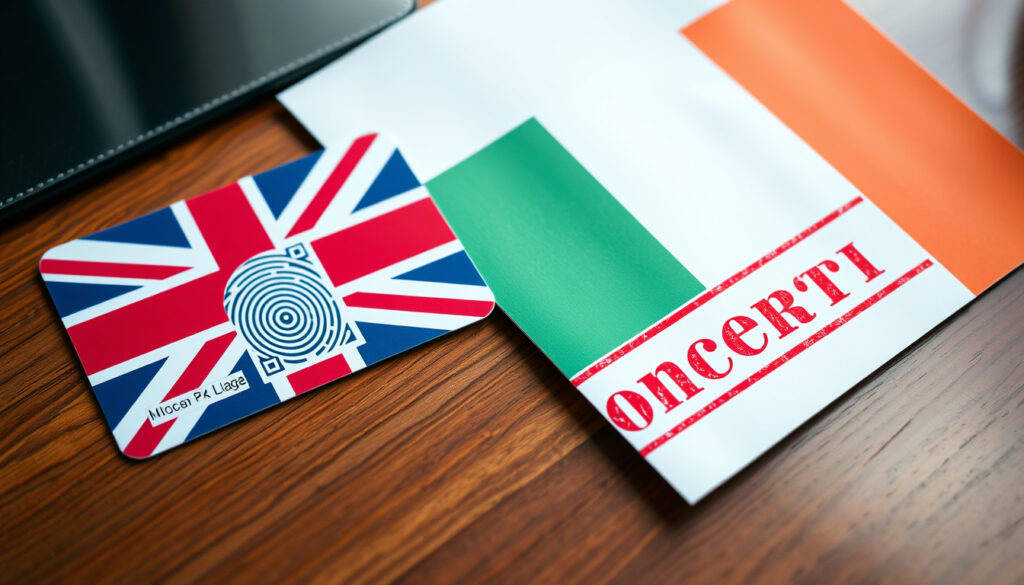
Iri h Government Concern Over UK Digital ID Scheme
Anyone who has crossed the Irish border for work knows the quiet liberty of not showing a passport — a freedom now tested by the UK’s revived push for digital ID cards, which has stirred old anxieties in Dublin. Freshly released State Papers reveal Irish officials once feared such a system could discriminate against their citizens, raising urgent questions for cross-border life and the Good Friday Agreement.
Year UK first proposed national ID cards: 2005 ·
Year plan abandoned: 2010 ·
Year UK digital ID scheme announced: 2025 ·
Irish government concerns documented in State Papers: December 2025
Quick snapshot
- Irish officials privately feared UK ID cards could discriminate against Irish citizens (RTÉ (Irish public broadcaster))
- Concerns disclosed in State Papers released December 2025 (RTÉ (Irish public broadcaster))
- 2005 UK ID card plan linked to reducing terrorism and fraud (RTÉ (Irish public broadcaster))
- UK government consulted Irish government on 2025 digital ID scheme (RTÉ (Irish public broadcaster))
- Exact impact of digital ID on cross-border workers still unknown
- Whether digital ID will be mandatory in Northern Ireland
- How data sharing will change under the new scheme
- Whether Irish citizens in Britain will face new documentary requirements
- 1998: Good Friday Agreement signed (RTÉ (Irish public broadcaster))
- 2005: UK proposes national ID cards (RTÉ (Irish public broadcaster))
- 2010: Plan abandoned under Conservative government (RTÉ (Irish public broadcaster))
- September 2025: UK announces digital ID scheme (The Irish Times (Ireland’s leading daily newspaper))
- December 2025: State Papers reveal Irish concerns (RTÉ (Irish public broadcaster))
- Legislation expected to advance before 2029 UK election
- Irish government likely to seek formal bilateral assurances
- Cross-border business groups may lobby for exemptions
Why are people concerned about digital ID in the UK?
What are the privacy implications?
- Irish officials feared that mandatory ID cards could create a registry that enables discrimination against Irish citizens in Northern Ireland and Britain (RTÉ (Irish public broadcaster)).
- The concern was that a centralised database could be used to check nationality, potentially undermining the right of people in Northern Ireland to identify as Irish, British, or both — a core protection of the 1998 Good Friday Agreement (RTÉ (Irish public broadcaster)).
- The British side offered one technical clarification: an ID card could be issued without the holder’s nationality shown on the face of the card (RTÉ (Irish public broadcaster)).
A system sold as a security tool could create a surveillance apparatus that forces Irish citizens — who historically faced discrimination in Britain — to prove a right that the Good Friday Agreement says they don’t need to prove.
How does the scheme affect cross-border workers?
- An estimated 30,000 people cross the Irish border daily for work or study, relying on the Common Travel Area (CTA) — a long-standing arrangement allowing free movement between Ireland and the UK (The Irish Times (Ireland’s leading daily newspaper)).
- Irish officials repeatedly raised concerns about people living on one side of the border and working on the other, who could face new documentary barriers if ID cards become mandatory (The Irish Times (Ireland’s leading daily newspaper)).
- The CTA was cited as a potential casualty of mandatory ID cards, since it currently operates without systematic identity checks (RTÉ (Irish public broadcaster)).
The implication: Each UK push for identity cards forces Irish citizens to confront whether their Good Friday Agreement protections will hold in practice.
What is the issue between Ireland and the UK?
What is the history of UK ID card proposals?
- The British government first proposed a national ID card system in 2005, framed as a tool to combat terrorism, illegal migration, identity fraud, and public administration inefficiency (RTÉ (Irish public broadcaster)).
- Legislation moved forward in 2006 (RTÉ (Irish public broadcaster)).
- The entire project was scrapped when David Cameron’s Conservative–Liberal Democrat coalition took office in 2010, with the Identity Documents Act 2010 formally abolishing the scheme (RTÉ (Irish public broadcaster)).
- In September 2025, the Labour government under Prime Minister Keir Starmer announced plans to introduce a digital ID system, with a target of deployment before the next Westminster election in 2029 (The Irish Times (Ireland’s leading daily newspaper)).
How does the Northern Ireland peace process relate?
- The 1998 Belfast Good Friday Agreement established the principle that people born in Northern Ireland can identify as Irish, British, or both (RTÉ (Irish public broadcaster)).
- Irish officials argued that mandatory ID cards could violate this right by forcing a binary nationality choice on the card — effectively requiring citizens to declare a single identity (RTÉ (Irish public broadcaster)).
- State Papers released in December 2025 reveal that these concerns were documented at the time, showing the Irish government’s deep unease with the 2005 plan (RTÉ (Irish public broadcaster)).
“The proposed identity card scheme could interfere with rights protected by the Belfast Agreement.”
— Irish official (State Papers, 2005, released December 2025 via RTÉ (Irish public broadcaster))
The pattern: Each time the UK proposes a national identity system, the same fundamental tension resurfaces — how to square a single-state identity card with the dual-nationality rights embedded in the Good Friday Agreement.
Do Ireland and the UK share immigration information?
What is the Common Travel Area?
- The CTA dates to 1923 and allows British and Irish citizens to move freely between the two countries without passport controls (RTÉ (Irish public broadcaster)).
- It was formally recognised in the Good Friday Agreement and later reaffirmed in a 2019 Memorandum of Understanding between the two governments.
- The CTA gives Irish citizens in the UK the right to work, study, vote, and access healthcare and social benefits on the same basis as British citizens.
Are there existing data-sharing agreements?
- The UK and Ireland share some immigration data under CTA arrangements, primarily to maintain border security while preserving free movement.
- The digital ID scheme could fundamentally alter these arrangements by creating a centralised identity database that links biometric and biographic data.
- Irish officials flagged in 2005 that mandatory ID cards could make the CTA effectively unworkable if card checks became routine (RTÉ (Irish public broadcaster)).
What this means: The digital ID proposal doesn’t just affect British citizens. Because the CTA is bilateral, a UK-only ID system with data-sharing capabilities could draw Ireland into a surveillance infrastructure it did not design or consent to.
Is it better to have a British or Irish passport?
Four key differences in rights and mobility, one pattern: the Irish passport offers greater global reach, but both offer reciprocal UK-Ireland benefits.
| Dimension | British passport | Irish passport |
|---|---|---|
| Right to live/work in the other country | Yes (CTA) | Yes (CTA) |
| Global mobility (visa-free destinations) | Approx. 185 countries | Approx. 192 countries (top 5 globally) |
| EU freedom of movement | No (post-Brexit) | Yes (Ireland remains EU member) |
| Vulnerability to UK digital ID scheme | Subject to scheme | May be affected if resident in UK |
| Nationality options (Northern Ireland) | British only, or both with Irish | Irish only, or both with British |
Under current plans, an Irish citizen living in Britain could face mandatory digital ID enrolment for access to healthcare, banking, or employment — even though they hold an Irish passport that the Good Friday Agreement says should be sufficient proof of identity and rights.
The trade-off: An Irish passport offers better global mobility and EU access. But for someone living in Belfast and commuting to Dublin, or living in London and voting in Irish elections, the choice isn’t about travel — it’s about which government’s digital infrastructure will govern their daily life.
The pattern: passport strength matters less than the jurisdiction that controls identity verification in your place of residence.
Will digital ID be mandatory in Ireland?
Is digital ID mandatory in the UK?
- The UK government has stated that the digital ID will not be mandatory for all citizens, but may be required to access certain public services, financial products, or employment verification (RTÉ (Irish public broadcaster)).
- Critics argue that “voluntary but required for services” creates de facto compulsion — the same criticism levelled at the 2005 scheme.
- Hilary Benn, UK Secretary of State for Northern Ireland, confirmed in September 2025 that the Irish government had been consulted on the cross-border implications of the digital ID scheme.
What are the opt-out options?
- Ireland has no current plan to introduce mandatory digital ID for its citizens.
- However, Irish citizens living in or travelling to the UK may still be affected by the UK scheme if it becomes a requirement for border crossings, employment, or services.
- The opt-out question remains unresolved: if a UK hospital requires digital ID for registration, an Irish citizen’s “choice” to opt out effectively means opting out of healthcare access.
“We have consulted the Irish government on our plans for digital ID, recognising the unique circumstances of Northern Ireland and the Common Travel Area.”
— Hilary Benn, UK Secretary of State for Northern Ireland (BBC, September 2025, reported via RTÉ (Irish public broadcaster))
Confirmed facts
- Irish government had documented concerns about the 2005 UK ID card plan (RTÉ (Irish public broadcaster))
- UK government consulted Irish government on the 2025 digital ID scheme
- State Papers released December 2025 confirm these concerns (RTÉ (Irish public broadcaster))
- 2005 ID card plan was linked to terrorism and fraud reduction (RTÉ (Irish public broadcaster))
- Plan abandoned in 2010 under Conservative government (RTÉ (Irish public broadcaster))
- Good Friday Agreement (1998) protects dual nationality rights (RTÉ (Irish public broadcaster))
What’s unclear
- Whether digital ID will be mandatory in Northern Ireland
- Exact impact of digital ID on cross-border workers
- How data sharing will change under the new scheme
- Whether the UK government will provide exemptions for Irish citizens
- Specific timeline for legislation advancing before 2029
- How the scheme will interact with the Irish Passport Office Warning about processing delays
Timeline
- 1998: Good Friday Agreement signed, establishing dual nationality rights in Northern Ireland (RTÉ (Irish public broadcaster))
- 2005: UK government proposes national ID cards; Irish officials raise concerns documented in State Papers (RTÉ (Irish public broadcaster))
- 2006: UK Identity Cards Act passed (RTÉ (Irish public broadcaster))
- 2010: Coalition government abandons ID card scheme (RTÉ (Irish public broadcaster))
- September 2025: UK Labour government announces digital ID scheme; Irish government consulted (The Irish Times (Ireland’s leading daily newspaper))
- December 2025: State Papers released revealing Irish concerns from 2005 (RTÉ (Irish public broadcaster))
“Irish officials were concerned about people living on one side of the border and working on the other. The idea that they would need an ID card to do that was seen as a fundamental change to the Common Travel Area.”
— The Irish Times (Ireland’s leading daily newspaper), reporting on State Papers
“The proposed identity card scheme could interfere with rights protected by the Belfast Agreement.”
— Irish official (State Papers, 2005, released December 2025 via RTÉ (Irish public broadcaster))
The State Papers tell a clear story: Irish officials were not objecting to British security policy. They were warning that a single identity system could unravel the careful dual-nationality architecture of the Good Friday Agreement — an architecture that the UK itself signed. For the thousands who cross the border daily, and the millions of Irish citizens living in Britain, the revived digital ID plan is not a distant policy debate. It is a concrete question: will the system designed to prove who you are end up restricting where you belong?
The consequence: without explicit exemptions, the UK’s digital identity infrastructure will govern daily life for Irish citizens who have never needed UK permission to prove who they are.
The Irish government’s concerns about the UK digital ID scheme highlight potential risks to cross-border rights under the Good Friday Agreement, as detailed in the UK digital ID scheme.
Frequently asked questions
What is Digital ID?
Digital ID is an electronic proof of identity that can be used for online and in-person verification. The UK government’s proposed system would link biometric data (such as facial image and fingerprints) to biographic details, creating a centralised identity database.
What if I don’t want to use a digital ID?
The UK government says the digital ID scheme will be voluntary for most purposes. However, it may be required for accessing certain public services, opening bank accounts, or verifying employment — creating effective compulsion. Irish citizens in the UK may face particular challenges if they cannot opt out without losing access to services. Those concerned about healthcare access should also review the HSE Organ Donation Opt Out: How to Register in Ireland guide for understanding how identity verification intersects with Irish health services.
Does having an Irish passport make you a dual citizen?
Ireland automatically grants citizenship to anyone born on the island of Ireland (including Northern Ireland). People born in Northern Ireland are entitled to hold both Irish and British passports. The Good Friday Agreement specifically protects the right to identify as Irish, British, or both.
Which countries don’t have ID cards?
Among developed nations, the UK, Ireland, the United States, Canada, Australia, and New Zealand do not have mandatory national identity cards. Most European Union countries (including Ireland, though not mandatory) issue optional identity cards. The UK’s proposed digital ID would represent a significant departure from its historical position.
Will UK digital ID affect Irish citizens in Northern Ireland?
Yes. Northern Ireland is part of the UK, so its residents would be subject to any UK digital ID scheme. This is particularly sensitive because the Good Friday Agreement guarantees the right of people in Northern Ireland to hold Irish citizenship — meaning the UK scheme would apply to Irish citizens living there.
Editor’s note: This article was updated in December 2025 following the release of State Papers revealing Irish government concerns about the 2005 UK ID card proposal. Information reflects the policy landscape as of that date.
More related posts
 India vs New Zealand 2026 Final Scorecard: Full T20 World Cup Result
 TYMO CurlPro Plus Review: Is It Worth the Hype? (2025)
 Irish Passport Office Warning: Urgent Advice for Travelers
 What Kills Toenail Fungus Instantly? Fast Home Remedies
 Play Bridge 4 Hands: Beginner’s Guide to Rules & Strategy
 Back to Wall Toilet Guide: Pros, Cons, Costs & Comparison
 Dyson V Hand Dryer: Specs, Worth It, Problems & Guide
 HSE Organ Donation Opt Out: How to Register in Ireland
