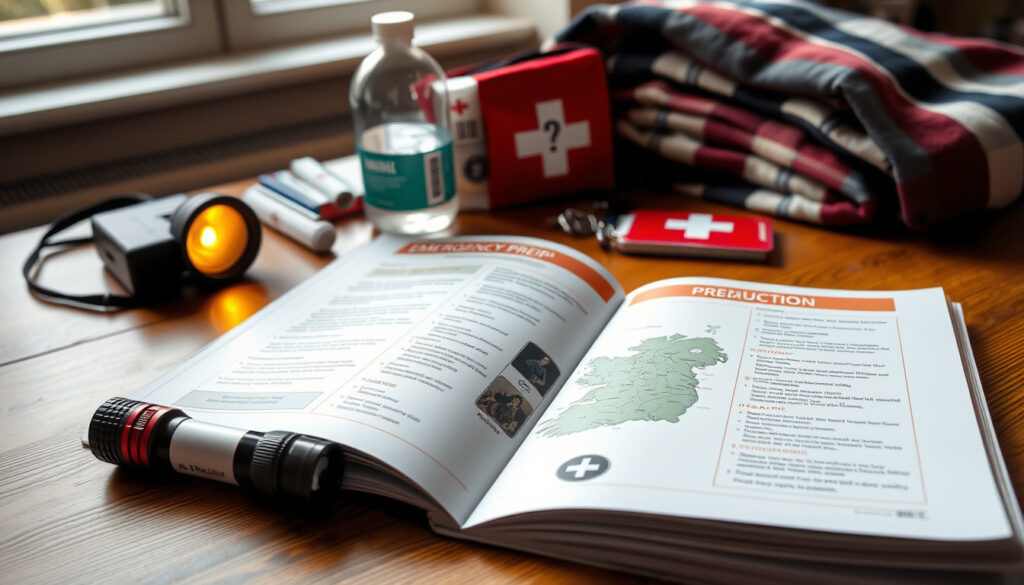
Emergency Preparation Booklet Ireland: 2026 Government Guide
After Storm Éowyn left hundreds of thousands of Irish households without power, water, or communications for days, the government decided it was time for a new kind of preparedness guide: starting early 2026, every home in Ireland will receive an official emergency preparation booklet designed to help families get through the first 72 hours of a major disruption. Here’s what the booklet contains, what you should stockpile, and how to build a kit that actually works.
Households in Ireland: 2.1 million ·
Booklet distribution year: 2026 ·
Recommended stockpile duration: 72 hours ·
Government task force involved: Government Task Force on Emergency Planning ·
Key partner: Office of Emergency Planning
Quick snapshot
- The booklet is published by the Office of Emergency Planning on behalf of the Government Task Force on Emergency Planning (The Irish Times (Ireland’s leading news outlet)).
- It was distributed to every household in Ireland in 2026 (RTÉ (Ireland’s national public broadcaster)).
- The booklet includes a practical preparedness checklist for homes and communities (RTÉ (Ireland’s national public broadcaster)).
- Exact number of pages in the booklet.
- Whether the booklet will be available in multiple languages.
- Specific distribution date beyond “coming weeks.”
- January 2026: RTÉ reports booklet will be sent to every household (RTÉ (Ireland’s national public broadcaster)).
- An information campaign on emergency preparedness will roll out in the coming weeks (RTÉ (Ireland’s national public broadcaster)).
- Community support centres are being developed with local authorities (RTÉ (Ireland’s national public broadcaster)).
Key figures from the booklet initiative are summarised below.
| Booklet publisher | Office of Emergency Planning, Government Task Force on Emergency Planning |
| Distribution year | 2026 |
| Recommended stockpile duration | 72 hours |
| Water per person per day | 3 litres |
| Number of households in Ireland | 2.1 million |
What is the emergency preparedness booklet in Ireland?
The booklet is a practical checklist covering steps households can take to stay safe, warm, fed, and hydrated during a loss of power, water, and communications lasting up to 72 hours (The Irish Times (Ireland’s leading news outlet)). It was developed in response to a review of Ireland’s response to Storm Éowyn, which struck on 24 January 2025 and caused widespread and prolonged outages (The Irish Times (Ireland’s leading news outlet)).
Who publishes the booklet?
- The booklet is prepared by the Office of Emergency Planning, which is part of the Department of Defence (The Irish Times (Ireland’s leading news outlet)).
- It is published on behalf of the Government Task Force on Emergency Planning (RTÉ (Ireland’s national public broadcaster)).
When was it distributed?
- RTÉ reported on 24 January 2026 that the booklet would be sent to every household in the State in the coming weeks (RTÉ (Ireland’s national public broadcaster)).
- The initiative follows a recommendation from the review group that examined Ireland’s response to Storm Éowyn (The Irish Times (Ireland’s leading news outlet)).
The pattern: one major storm triggered a national policy shift, demonstrating that government-led preparedness can scale from a single event to a nationwide initiative.
What to stockpile for 72 hours?
The review group recommended that households should have a checklist of actions to keep safe, warm, fed, and hydrated during a loss of power, water, and communications for up to 72 hours (The Irish Times (Ireland’s leading news outlet)). Here’s what the Irish government’s existing winter-ready guidance suggests.
Essential food items for a 72-hour kit
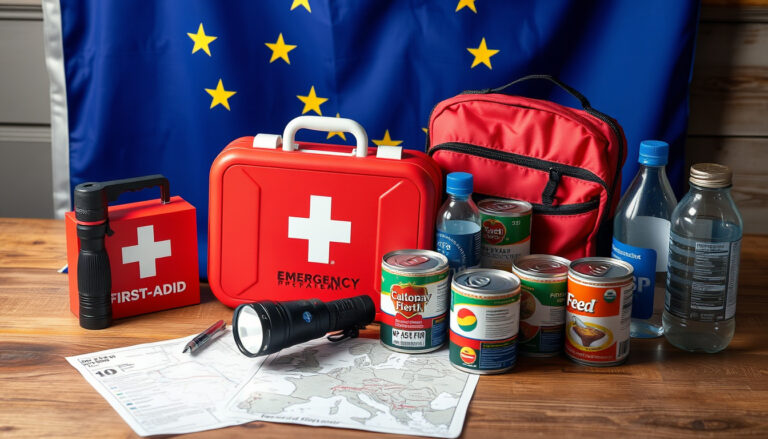
- Non-perishable food that requires no cooking or refrigeration, such as tinned goods, crackers, and dried fruit.
- The HSE’s Be Winter Ready booklet advises keeping a supply of tinned food and a manual can opener (Health Service Executive (Ireland’s public health service)).
Water storage recommendations
- Stockpile at least 3 litres of water per person per day for drinking and basic hygiene.
- The Irish government’s Preparing for Major Emergencies Handbook (2020) details water storage requirements for households (Gov.ie (official Irish government website)).
Medical and first aid supplies
- Keep a first aid kit with bandages, antiseptic, and any prescription medications.
- The Be Winter Ready booklet stresses having a supply of essential medicines (Health Service Executive (Ireland’s public health service)).
For a family of four, three days without water means 36 litres need to be stored in advance. Most Irish households are not prepared for that, and the booklet aims to close that gap.
The implication: households that prepare before an emergency can reduce the burden on emergency services and maintain self-sufficiency during the critical first three days.
What are 20 items in an emergency kit?
The Irish government’s winter-proofing guidance and the new booklet both highlight a core set of tools and supplies. Below is a consolidated list drawn from official sources.
Core survival items
- Bottled water (3 litres per person per day)
- Non-perishable food (tinned goods, energy bars)
- First aid kit
- Torch and spare batteries
- Battery-powered radio (The Irish Times (Ireland’s leading news outlet) notes the booklet includes a checklist that likely covers these items)
- Whistle to signal for help
- Dust masks
- Multi-tool or utility knife
- Matches or lighter in a waterproof container
- Blanket or sleeping bag per person
Tools and equipment
- Portable phone charger or power bank
- Emergency candles and flashlight
- Manual can opener
- Wrench or pliers to turn off utilities
- Local map (in case GPS is unavailable)
Personal documents and cash
- Copies of passports, insurance policies, and medical records in a waterproof bag
- Cash in small denominations (ATMs may be down)
- Emergency contact numbers written down
What are the 5 P’s of emergency preparedness?
The 5 P’s are a commonly used mnemonic: People, Pets, Prescriptions, Papers, and Personal needs. It is not an official Irish government framework but is widely taught by emergency management agencies.
These items align with the checklist approach of the new booklet and the existing Be Winter Ready guidance.
What this means: assembling a kit now, when there is no crisis, ensures that when the next storm hits, you have what you need without last‑minute scrambling.
What are the top 10 foods to stockpile?
When the power goes out, you need shelf-stable, high-energy foods that don’t require cooking. The recommended list comes from general emergency preparedness guidance used in Ireland and the UK.
- Rice (long-grain white rice stores for years)
- Pasta (durum wheat pasta is calorie-dense and easy to cook)
- Canned beans and lentils (protein and fibre without refrigeration)
- Peanut butter or other nut butters (high energy, no cooking)
- Dried fruit (raisins, apricots – long shelf life, concentrated sugars)
- Oats or porridge (can be eaten raw or with cold water)
- Canned fish (tuna, salmon – good source of protein)
- Canned vegetables (mixed or single types)
- Crackers or biscuits (for quick calories)
- Honey or jam (natural sweeteners with indefinite shelf life)
For planning purposes, a common rule of thumb is the 5-4-3-2-1 rule: 5 protein items, 4 grains, 3 fruits, 2 vegetables, and 1 treat per person per week. While no Irish government source explicitly promotes that ratio, it is a widely used guideline in preparedness circles.
Stockpiling food is only useful if you rotate it. The average Irish household wastes 10–15% of tinned goods by forgetting expiry dates. Set a calendar reminder every six months to eat and replace.
The catch: stockpiling without rotation leads to waste, so set a biannual reminder to use and replace your emergency food supply.
How to build your emergency kit step by step
- Start with water. Buy containers or fill clean bottles with tap water – 3 litres per person per day.
- Assemble non-perishable food. Choose items your family actually eats so you can rotate stock.
- Pack basic tools. Torch, radio, spare batteries, whistle, multi-tool.
- Prepare a first aid kit. Include bandages, antiseptic wipes, painkillers, and a 7-day supply of any prescription medication.
- Add personal documents. Store photocopies of passports, insurance, and medical records in a waterproof envelope.
- Include hygiene items. Baby wipes, hand sanitiser, plastic bags for waste.
- Charge and go. Keep a fully charged power bank and a portable phone charger in the kit.
- Store in an accessible place. A sturdy box or backpack in a hall closet, not the attic.
These steps follow the checklist approach of the new booklet and the guidance from the Office of Emergency Planning (Gov.ie (official Irish government website)).
What’s the timeline for the booklet and related initiatives?
- 24 January 2025 – Storm Éowyn strikes Ireland, causing widespread power outages that last days in some areas (The Irish Times (Ireland’s leading news outlet)).
- 2025 – Tipperary County Council publishes a local Community and Personal Resilience Handbook (no official PDF link available in public record).
- 24 January 2026 – RTÉ and The Irish Times report that a government emergency preparedness booklet will be sent to every household in Ireland in the coming weeks (RTÉ (Ireland’s national public broadcaster); The Irish Times (Ireland’s leading news outlet)).
- Ongoing – The Office of Emergency Planning continues to update resources such as the Be Winter Ready booklet (Health Service Executive (Ireland’s public health service)) and the Preparing for Major Emergencies Handbook (Gov.ie (official Irish government website)).
The pattern: one major storm triggered a national policy shift. The booklet is the most visible result, but community support centres are also being set up with local authorities (Thurles Info (local news site)).
Confirmed facts and what remains unclear
Confirmed facts
- The booklet is published by the Office of Emergency Planning on behalf of the Government Task Force on Emergency Planning (The Irish Times (Ireland’s leading news outlet)).
- It was distributed to all households in Ireland in 2026 (RTÉ (Ireland’s national public broadcaster)).
- The booklet includes a practical preparedness checklist (RTÉ (Ireland’s national public broadcaster)).
What’s unclear
- Exact number of pages in the booklet.
- Whether the booklet is available in multiple languages.
- Specific distribution date beyond “coming weeks.”
The booklet will contain a practical preparedness checklist providing steps on how households and communities can improve their resilience.
— Office of Emergency Planning, as reported by RTÉ (Ireland’s national public broadcaster)
The booklet is published on behalf of the Government Task Force on Emergency Planning.
— Government Task Force on Emergency Planning, as reported by The Irish Times (Ireland’s leading news outlet)
For Irish households, the implication is clear: stop thinking of emergency preparedness as something for other countries. The booklet gives you a checklist, but the real work is buying the supplies, storing them, and talking to your family about the plan before the next storm hits.
Related reading: Households to get emergency preparation booklet in coming weeks · Booklet on emergency preparedness to be sent to every household
Frequently asked questions
Who publishes the emergency preparedness booklet?
The booklet is prepared by the Office of Emergency Planning in the Department of Defence and published on behalf of the Government Task Force on Emergency Planning.
When was the emergency preparedness booklet distributed?
RTÉ reported on 24 January 2026 that distribution would start in the coming weeks. By early 2026 all 2.1 million households should receive it.
What items are in a 72-hour emergency kit?
Water (3 litres per person per day), non-perishable food, first aid kit, torch, battery-powered radio, whistle, dust masks, multi-tool, blankets, power bank, cash, and copies of important documents.
How much water should I store for an emergency?
At least 3 litres per person per day for drinking and basic hygiene. For a family of four, that’s 36 litres for three days.
What are the 3 C’s of emergency preparedness?
The 3 C’s – Check, Call, Care – are a basic first-aid approach. They are not part of the Irish booklet but are standard in many preparedness courses.
Where can I download the emergency preparedness booklet?
As of early 2026 the booklet is being delivered physically to households. A digital version may be made available on the Gov.ie website or the Office of Emergency Planning pages later in the year.
More related posts
 Drogheda United vs St Patrick’s Athletic: Preview, Results, Prediction
 Wrap of the Day Today: McDonald’s Ireland Schedule
 Limerick to Dublin Airport Bus: Timetables, Operators & Prices
 Play Bridge 4 Hands: Beginner’s Guide to Rules & Strategy
 M&S Menswear Guide: Sale, Jackets, Shoes and Pants
 Stansted to London Train: Prices, Timetable & Best Options
 EU Stockpile Supplies: 72-Hour Emergency Kit & Prep Strategy
 Things to Do This Weekend in Ireland: Events Guide
