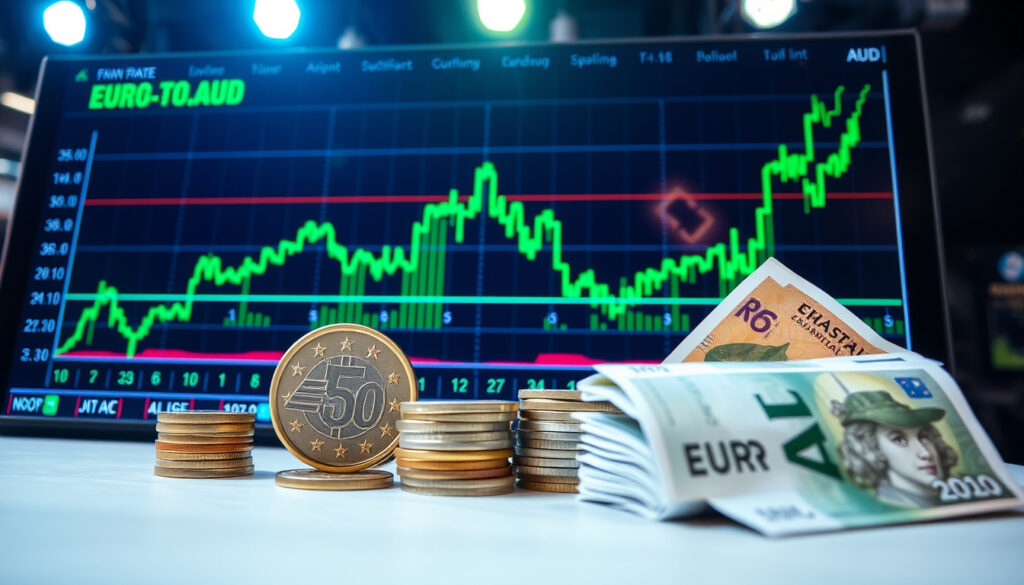
Euro to Australian Dollar Exchange Rate: Live EUR to AUD
The EUR/AUD rate matters whether you’re sending money to family in Sydney or planning a trip Down Under. Right now, one euro buys roughly 1.64 Australian dollars, and knowing where to find reliable data can save you real money.
1 EUR to AUD (mid-market): 1.6438 · 100 EUR to AUD: 164.38 AUD · 1000 EUR to AUD: 1,643.80 AUD · Historical data available: Up to 20+ years · Live rates from: XE, Wise
Quick snapshot
- ECB set EUR/AUD at 1.6438 on April 17, 2026 (European Central Bank)
- EUR interest rate: 4.25% vs AUD 3.60% in 2026 (XE)
- Forward forecasts lack analyst consensus beyond 6 months
- Impact of specific RBA or ECB policy shifts not yet quantified
- Rate differentials and commodity prices likely to drive near-term moves
- Monitor RBA and ECB announcements for policy-driven shifts
EUR to AUD Key Facts Table
The table below aggregates mid-market rates and historical ranges from official and verified sources. Actual transfer rates will include provider markups.
| Amount | AUD Equivalent | Source |
|---|---|---|
| 1 EUR | 1.6438 AUD | ECB |
| 100 EUR | 164.38 AUD | OFX |
| 1000 EUR | 1,643.80 AUD | OFX |
| History | Up to 20+ years | Wise |
| 52-week range | 1.6117 – 1.8167 | Investing.com |
| Oct 2025 peak | 1.8053 AUD | Wise |
The 52-week range of 1.6117 to 1.8167 shows roughly 12.7% intra-year volatility, meaning the EUR/AUD pair can swing meaningfully based on central bank policy and commodity demand.
What is €100 Euro in Australian dollars?
Using the ECB reference rate of 1.6438 as of April 17, 2026, one hundred euros converts to approximately 164.38 Australian dollars. This mid-market rate represents the theoretical exchange point between currencies before any provider markup is applied. For travelers or businesses making actual transfers, rates will vary slightly depending on the platform used. OFX listed 1.660364 on April 15, 2026, while Xe showed 1.67069646, and Wise quoted 1.629 AUD per euro at various points during the week. The spread between the lowest and highest provider rate on any given day typically stays under 2%, but that difference adds up on larger transfers.
To calculate conversions manually, multiply your euro amount by the current rate. For example: €100 × 1.6438 = A$164.38. For €500, that becomes A$821.90, and €1,000 equals approximately A$1,643.80. Wise’s historical data shows weekly highs reaching 1.66826 AUD on April 12, 2026, and lows dropping to 1.64042 AUD by April 17, 2026, illustrating how intraday and weekly volatility affects the final amount received.
For a €100 transfer, choosing the right provider over the worst one can mean the difference of A$5–A$8. That’s a lunch in Melbourne or a decent bottle of wine in Bordeaux.
What is €1000 in Australian dollars?
Converting one thousand euros at the current ECB reference rate of 1.6438 gives you roughly A$1,643.80. At OFX’s rate from mid-April 2026 (1.660364), the same amount yields approximately A$1,660.36—about A$16.56 more. That margin is meaningful for businesses moving regular volumes or families relying on transfers for living expenses abroad.
The gap widens further with Revolut, which reported 1.77980 AUD per euro on the same date, delivering A$1,779.80 for €1,000—though Revolut notes rates fluctuate with market conditions and advises checking in-app for precise figures. For larger transfers, even a 0.05-point rate difference translates to €50–€500 in extra AUD received.
OFX and similar specialist providers often beat banks by 2–4% on international transfers, according to their marketing materials, which matters when sending €10,000 or more. Wise offers free rate alerts and historical charts so users can track trends and trigger transfers when rates hit personal targets.
Why is the AUD so weak against the Euro?
The Australian dollar has weakened against the euro primarily because interest rate differentials favor the European currency. The ECB maintained its rate at 4.25% while the Reserve Bank of Australia sits at 3.60%—a 0.65 percentage point gap that attracts capital toward higher-yielding euro-denominated assets.
The EUR/AUD pair dropped from a October 2025 average of 1.778405 to 1.649452 by March 2026, reflecting an 8.12% decline over the year according to Investing.com data. October 17, 2025, saw the six-month peak at 1.8053, and the pair has been grinding downward since. RBA publishes official exchange rates and trade-weighted index figures annually, providing institutional data on Australia’s external position.
Commodity prices, particularly iron ore and coal which drive Australia’s export revenues, influence the AUD’s purchasing power. China’s economic slowdown reduces demand for Australian raw materials, putting downward pressure on the currency. Meanwhile, Europe’s relatively higher interest rates maintain euro strength despite economic challenges in the eurozone.
Australian importers and students paying tuition in euros benefit from weaker AUD—it costs more in local terms. Australian exporters and Europeans receiving AUD from sales see the opposite effect.
Is AUD expected to rise or fall?
Current trends suggest continued mild downward pressure on EUR/AUD based on 2026 monthly averages, though forward forecasts lack strong analyst consensus beyond six months. The 52-week range spans 1.6117 to 1.8167, and the pair recently settled near the lower end of that range, suggesting limited downside from current levels but also constrained upside without a catalyst.
TradingView recorded the rate at 1.64132 AUD on recent trading, down 0.23% over 24 hours, showing continued day-to-day volatility. The ECB reference rate on April 17, 2026, showed only a 0.0013 change from the same date in 2025, indicating relative stability over the full year despite intra-year swings.
RBA and ECB policy divergence can move markets. A break below 1.61 signals deeper weakness; above 1.68 suggests reversal momentum.
What are the best days to exchange currency?
The foreign exchange market operates 24 hours, five days a week, but liquidity peaks during overlapping sessions between European and North American markets. Tuesday through Thursday typically see the tightest spreads, while Mondays and Fridays often experience wider ranges due to weekend news accumulation and reduced liquidity.
Historical daily ranges from Investing.com show volatility of approximately ±0.5% on active trading days, meaning a 1.64 rate could realistically move between 1.6316 and 1.6484 in a single session. For large transfers, setting rate alerts on platforms like Wise lets you monitor thresholds and execute when the rate hits your target.
RBA rate decisions and Australian employment data typically drop on set calendars. European Central Bank announcements follow their published schedule. Aligning transfers around these events—after the initial volatility settles—often produces better outcomes.
Summary
For European businesses receiving Australian dollars or Australian residents paying euro-zone expenses, the current environment offers a mixed picture: the euro remains stronger than its 2025 peak but off its highs, creating a window where favorable rates may still be available. Monitor rate alerts, compare provider spreads before committing, and avoid transferring during high-volatility announcement windows unless rate certainty matters more than marginal gains.
Bottom line: The EUR/AUD rate sits around 1.64, down roughly 8% from its 2025 peak of 1.81. For those converting euros to Australian dollars, the window of favorable rates is still open, but provider choice can swing outcomes by A$5–A$8 on every €100 transferred.
“Live rates as at Apr 15, 2026, 5:27 AM (CUT): 1 euro = 1.660364 Australian dollar.”
“The highest Euro to Australian dollars rate was on October 17, 2025 when 1 Euro was worth 1.8053 Australian dollar.”
Related reading: 1 Euro in Rupees
ofx.com, revolut.com, revolut.com, xe.com, mtfxgroup.com, airwallex.com
For instance, five hundred euros currently converts to about 875 to 891 Australian dollars according to the 500 Euro to AUD guide, depending on market timing.
Frequently asked questions
How much is $100 in Australian dollars in Euros?
At the current inverse rate of approximately 0.6083 EUR per AUD, A$100 converts to about €60.83. Using OFX’s April 2026 rate (1.660364 EUR/AUD), the inverse would be roughly €0.6023 per AUD. Check live rates for the most current figure.
What is $1000 Australian in Euros?
Dividing 1,000 AUD by the current EUR/AUD rate of 1.6438 gives approximately €608.28. At the OFX rate of 1.660364 from April 15, 2026, A$1,000 equals roughly €602.28.
Why is AUD so strong now?
The AUD has actually weakened against the EUR in recent months, dropping from 1.78+ in late 2025 to around 1.64–1.67 in early 2026. Commodity demand and RBA policy influence AUD strength, but the interest rate differential (EUR at 4.25% vs AUD at 3.60%) currently favors the euro.
What is the highest the euro has been against the AUD?
The 52-week high for EUR/AUD reached 1.8167 according to Investing.com data, with the six-month peak at 1.8053 recorded on October 17, 2025. The 52-week low stands at 1.6117.
Is the Australian dollar getting stronger or weaker against the Euro?
Weaker. The EUR/AUD pair has declined roughly 8.12% over the past year, moving from above 1.78 to the 1.64–1.67 range. This means each euro buys fewer Australian dollars—a sign of euro strength rather than AUD resilience.
Convert 100 AUD to EUR?
Using the ECB rate of 1.6438, 100 AUD ÷ 1.6438 = approximately €60.83. At Xe or Wise rates, the figure will differ slightly. Always use the provider’s live rate for accurate conversion.
More related posts
 Kodi Smit-McPhee: Movies, Age, Girlfriend, Facts & Career
 Ray Cooke Houses for Sale in Dublin: Listings & Guide
 We Bury the Dead: Where to Watch, Cast, Reviews (2026)
 Drogheda United vs St Patrick’s Athletic: Preview, Results, Prediction
 Maldron Hotel Sandy Road Galway: Location, Reviews, Prices
 12 Grapes Under the Table: Timing, Steps & Wishes
 Mini Golf Near Me in Dublin: Best Indoor & Outdoor Guide
 Panda Waste Price List 2025: Dublin Costs & Comparisons
