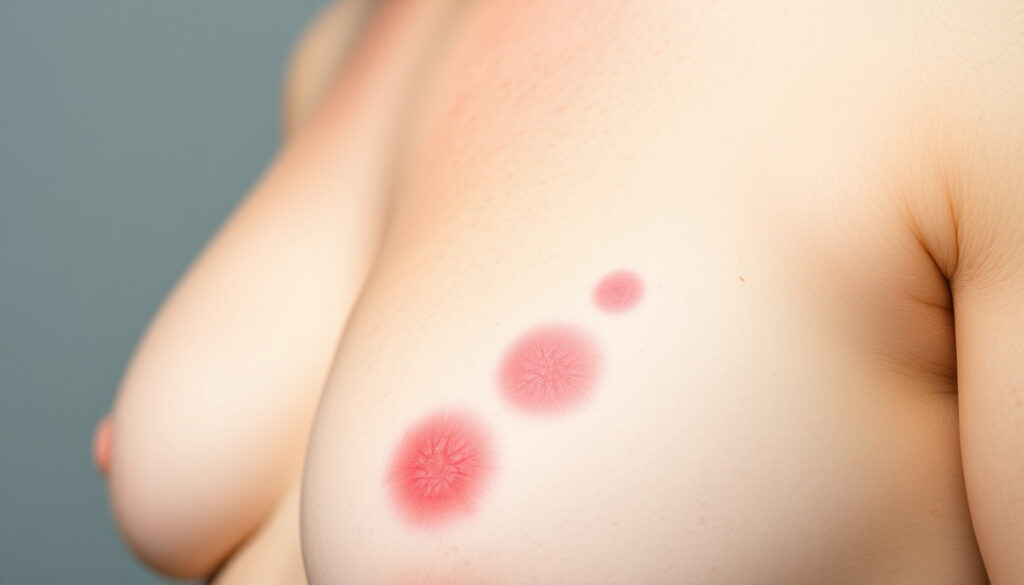
Very Early Inflammatory Breast Cancer Rash: Signs & Pictures
Many people have heard of breast cancer, but fewer know that a rash can sometimes be the first signal — not a lump. Inflammatory breast cancer (IBC) is rare, accounting for only 1–5% of breast cancers, yet it moves fast. The red, swollen appearance it causes is easy to mistake for an infection or skin irritation, which is exactly what makes it so dangerous. This article walks through what the earliest IBC rash actually looks and feels like, drawing on survivor experiences and guidance from major cancer centers, so you know what to watch for and when to seek care.
Rash onset speed: Appears quickly, sometimes overnight · Common first symptom: Rashes or skin irritation · Typical coverage: One-third or more of breast · Initial appearance: Redness, swelling, spot-like rash
Quick snapshot
- Rash is typically the first symptom of IBC (Breast Cancer Research Foundation)
- 69.8% of patients report redness, 48.6% report swelling (Health Central)
- Redness covering one-third or more of the breast is a diagnostic marker (UCSF Surgical Oncology)
- How the rash first appears in the very earliest stage — before rapid spread
- Exact trigger factors that initiate IBC development
- Variability in visual presentation across different skin tones
- Symptoms develop within weeks to months (NCBI Bookshelf (StatPearls))
- For diagnosis, symptoms must be present less than six months (Mayo Clinic)
- IBC is usually stage III or IV at diagnosis — early recognition is critical (UCSF Surgical Oncology)
- About one-third of patients already have distant metastasis at presentation (UCSF Surgical Oncology)
| Attribute | Detail |
|---|---|
| Rash location | Usually one breast |
| Onset time | Days to weeks |
| Associated changes | Swelling, dimpling (peau d’orange) |
| Lump presence | Often absent early |
| Skin color change | Pink, reddish-purple, or bruised appearance |
| Coverage threshold | ≥33% of breast (one-third or more) |
Does early inflammatory breast cancer rash come and go?
Unlike common skin irritations that fade with time or basic treatments, the IBC rash typically persists and worsens rapidly. The Breast Cancer Research Foundation notes that IBC rashes tend to spread quickly compared to other types of breast rashes. This persistence is a key feature that distinguishes it from benign conditions.
Persistence of rash symptoms
The rash does not come and go like some benign conditions. Instead, once it appears, it progresses. Mayo Clinic describes a “fast change in the appearance of one breast” over several weeks. If you notice a rash on your breast that isn’t improving after a week or two — especially if it’s spreading — that persistence is itself a reason to see a doctor.
Comparison to other rashes
Most common breast rashes caused by eczema, contact dermatitis, or fungal infections tend to be localized, stable, and responsive to standard creams. The IBC rash behaves differently: it expands, often accompanied by warmth, swelling, and skin texture changes. According to NCBI StatPearls, IBC symptoms develop and can worsen within just a few weeks.
What were your first IBC symptoms?
Hearing from people who have lived through IBC provides some of the clearest clues about how this cancer announces itself early. Survivor accounts consistently describe a cluster of symptoms that seemed mild at first but quickly intensified.
Survivor-reported early signs
Many survivors describe an early spot-like rash or area of skin irritation that seemed minor but wouldn’t go away. Some noticed their bra suddenly didn’t fit right because of swelling — even before visible redness appeared. Others first saw redness that looked like a bruise on one breast. According to BCRF, IBC rashes may initially appear as an irritation of the skin or red bumps, or may look like bruising on one breast. These descriptions from patients align closely with what oncologists now recognize as the hallmark early presentation.
Common patterns in initial symptoms
Looking across patient reports, several patterns emerge. First, the symptoms are almost always on one side only. Second, the skin changes come on faster than expected — sometimes noticed within days of a bra fitting change. Third, unlike a typical skin rash, there is often underlying swelling and warmth. Mayo Clinic confirms that unusual warmth of the affected breast is a symptom of inflammatory breast cancer.
The symptoms that seem most alarming — visible redness, swelling, warmth — are exactly what causes IBC to be mistaken for mastitis, especially in younger women or those who are pregnant or breastfeeding. NCBI StatPearls notes that most IBC patients are initially treated with antibiotics for presumed mastitis or abscess.
What does an IBC spot look like?
The visual appearance of early IBC varies, but there are consistent patterns that trained observers — and patients who later reflected on their experience — have identified.
Visual characteristics of early spots
The early IBC spot often resembles a red bump, patch of irritation, or an area that looks bruised. UCSF Surgical Oncology describes that the skin may appear pink, reddish-purple, or bruised in inflammatory breast cancer. On darker skin tones, the color change may appear more purple than red. Health Central reports that changes in skin coloration in IBC can take the form of redness in those with lighter skin tones, or an area that may look purple in darker skin tones.
Differences from stage 1 IBC
Inflammatory breast cancer is classified as T4d in the AJCC TNM staging system and is technically always at least stage III at diagnosis because of how it presents — there is no “stage 1 IBC” in the traditional sense. According to UCSF Surgical Oncology, at diagnosis, inflammatory breast cancer is either stage III or IV disease. This means the “early” stage refers to the very first weeks of symptoms, before the cancer has spread beyond the breast and regional lymph nodes. The early rash may be subtle, but it progresses quickly in that window.
There is no true Stage 1 IBC. By definition, IBC is a locally advanced cancer at presentation. What you see in the very first weeks — a spot, a patch of redness, a bit of swelling — is the beginning of a stage III or IV cancer. Recognizing it as early as possible still matters for treatment options and outcomes.
Do you get a rash with inflammatory breast cancer?
Yes — the rash is not just associated with IBC, it is often the presenting feature. The Breast Cancer Research Foundation confirms that rashes are typically the first symptom of inflammatory breast cancer.
Rash prevalence in IBC
Data from a Cancer Medicine study of 701 IBC participants shows just how common skin changes are: 69.8% reported redness and 48.6% reported swelling associated with their diagnosis. These are not rare occurrences — they are the majority experience. The redness reflects the inflammatory process caused by cancer cells blocking lymphatic vessels in the skin, which prevents the normal flow of fluid through the tissue, as Health Central explains.
Where rash usually starts
The rash almost always starts on one breast and spreads from there. According to Mayo Clinic, the fast change in the appearance of one breast occurs over the course of several weeks. It rarely begins on both sides simultaneously. The Breast Cancer Research Foundation notes that redness or a rash affecting more than one-third of the breast is a key diagnostic feature — meaning the rash expands, rather than staying as a tiny isolated spot.
Associated skin changes
Peau d’orange — the dimpled, pitted skin texture resembling an orange peel — is a hallmark symptom of IBC that often develops alongside the rash. This occurs because lymphatic vessels in the skin become blocked by cancer cells, leading to sudden alterations in the breast’s appearance and feel. Mayo Clinic also notes that a flattened nipple or nipple that turns inward on the affected breast is a symptom of IBC.
If you have a rash on one breast that is accompanied by swelling, warmth, or skin texture changes — and it’s not getting better — that combination of symptoms warrants an urgent medical evaluation. Call your doctor or gynecologist and ask specifically whether inflammatory breast cancer should be ruled out.
How to tell if a rash is cancerous?
Not every breast rash is cancer, but certain features raise concern. Knowing the red flags — and acting on them — can be the difference between an early diagnosis and a delayed one.
Key red flags for IBC rash
According to BCRF, the combination that matters most is a rash that covers one-third or more of the breast, appears on one side only, and is accompanied by swelling or skin dimpling. The absence of a lump is actually common in IBC — many patients never feel a distinct lump. Instead, they notice the visual and textural changes to the skin. Mayo Clinic adds that enlarged lymph nodes under the arm, above the collarbone, or below the collarbone are associated with IBC, so feeling tender or swollen nodes in those areas alongside a breast rash is an additional red flag.
When to seek medical help
If your breast rash has any of the following, see a doctor promptly: it is on one side only; it is spreading or getting worse after more than a week; you also have swelling, warmth, or skin dimpling; your nipple has changed position or appearance; or you feel tender lymph nodes near your collarbone or under your arm. BCRF notes that inflammatory breast cancer is often diagnosed at a locally advanced stage because it is difficult to detect early by mammograms and other imaging techniques — which means your own awareness matters more than usual.
Most benign breast rashes improve with standard treatment within one to two weeks. If yours is not improving — or if it is worsening — that single fact is enough to ask your doctor for a second opinion or imaging. You do not need all the red flags at once. Persistence alone is worth a check.
What experts and survivors say
The clinical descriptions from major cancer centers and the lived experiences of IBC survivors often paint the same picture, just from different angles. Combining both gives a fuller sense of what to look for — and how to act on it.
“The rash does not come and go. Once it appears, it progresses. If you notice a rash on your breast that is not improving after a week or two — especially if it is spreading — that persistence is itself a reason to see a doctor.”
— Breast Cancer Research Foundation
“Most IBC patients are initially treated with antibiotics for presumed mastitis or abscess and seek expert advice after no clinical improvement.”
— NCBI Bookshelf (StatPearls)
This pattern — being treated for an infection first, then referred for testing after the antibiotics fail — is one of the most documented delays in IBC diagnosis. It is not a failure of patients or even of initial care. It reflects how much IBC mimics common, benign conditions. The key shift is recognizing that when the treatment for an infection isn’t working, that’s not proof the rash is benign — it’s a signal to investigate further.
IBC accounts for only 1–5% of breast cancers, but it accounts for a disproportionate share of deaths from breast cancer because it is so often diagnosed late. BCRF notes that women with IBC tend to have a worse prognosis than women with other common types of breast cancer. Early recognition — even a few weeks sooner — can meaningfully affect what treatment options are available.
Related reading: What Is Magnesium Good For? Benefits, Uses & Deficiency Signs
massivebio.com, medicalnewstoday.com, mdanderson.org, youtube.com, iuhealth.org, patientpower.info, theibcnetwork.org
Reviewing early-stage inflammatory breast cancer pictures across skin tones helps distinguish the rapid redness from infections effectively.
Frequently asked questions
What is inflammatory breast cancer?
Inflammatory breast cancer is a rare, aggressive form of breast cancer where cancer cells block lymphatic vessels in the skin of the breast, causing redness, swelling, and a rash-like appearance. It is classified as T4d in the AJCC TNM staging system and is typically stage III or IV at diagnosis.
How is IBC diagnosed?
IBC is diagnosed through a combination of clinical examination (checking for rapid-onset redness, swelling, and skin changes), imaging (mammogram, ultrasound, or MRI), and a skin biopsy. According to Mayo Clinic, for IBC to be diagnosed, symptoms must have been present for less than six months.
What causes inflammatory breast cancer?
IBC develops when cancer cells grow and block the lymphatic vessels in the breast skin, causing the inflammatory appearance. The exact cause of why some people develop IBC is not fully understood, but it involves rapid cell growth and invasion of the lymphatic system.
Is inflammatory breast cancer curable?
IBC is aggressive, but treatable. When caught early — within the first weeks of symptoms — treatment is more effective. BCRF notes that women with IBC tend to have a worse prognosis than women with other common types of breast cancer, but outcomes have improved with modern targeted therapies. About one-third of patients already have metastatic disease at diagnosis, which affects curability.
What treatments are used for IBC?
Treatment typically involves chemotherapy first to shrink the tumor, followed by surgery (often mastectomy), radiation, and sometimes targeted therapies or hormone therapy depending on the tumor type. Because IBC is usually stage III or IV at diagnosis, a multimodal approach is standard.
How common is IBC?
IBC is rare, accounting for only 1–5% of all breast cancers diagnosed in the United States. It tends to affect women slightly younger than those diagnosed with other breast cancers and is more aggressive in its clinical course.
Can IBC be prevented?
There is no known way to prevent IBC, but early recognition of symptoms is the best tool for improving outcomes. Knowing the red flags — rapid-onset rash on one breast with swelling, warmth, or skin texture changes — can lead to faster diagnosis and treatment.
For anyone who notices a rash on one breast that is persisting, spreading, or accompanied by swelling, warmth, or skin changes — the next step is clear: call your doctor today and ask whether inflammatory breast cancer needs to be ruled out. The symptoms of IBC are easy to dismiss as an infection or skin irritation. They are not worth waiting to see if they resolve on their own.
More related posts
 Things to Do in Edinburgh City: Top Attractions & 2-Day Plan
 Serie A Matches: Schedule, Results & Standings 2025
 DJI Osmo Action 4 in 2026: Is This Camera Still Worth Buying?
 Pet Store Near Me: Best Irish Pet Shops Compared
 Healthy Food Near Me: Best Dublin Picks & Tips
 Who Is Charlie Kirk? Biography, Death, and Legacy.
 Play Bridge 4 Hands: Beginner’s Guide to Rules & Strategy
 Cult Beauty 2025 Advent Calendar: Price, Worth & Contents
