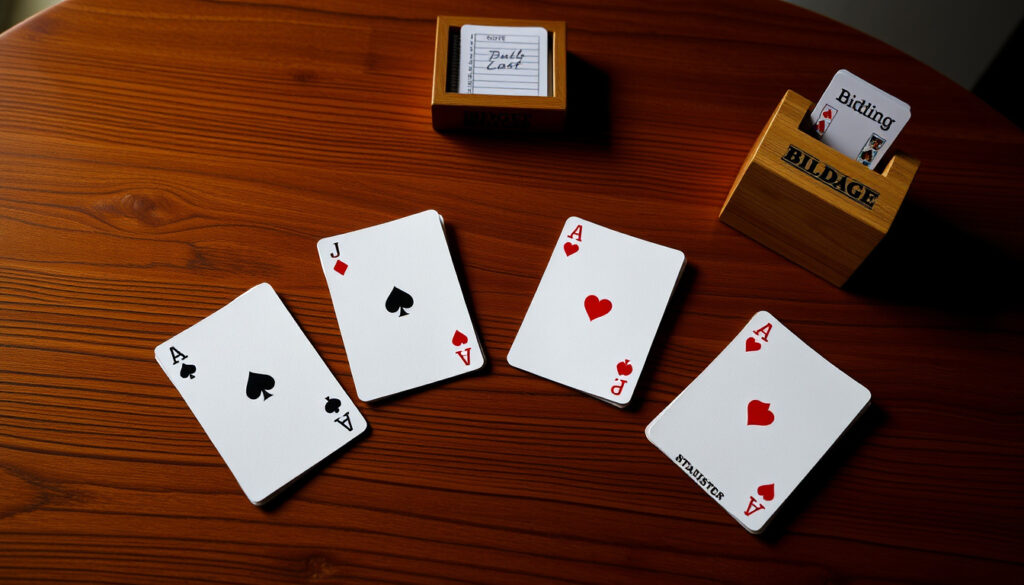
Play Bridge 4 Hands: Beginner’s Guide to Rules & Strategy
There’s something quietly magnetic about a card table where four people settle in, two partnerships whispering signals across the felt — and bridge is one of those rare games that rewards a 20-minute learning session with decades of strategic depth, with the 4-hand format being the perfect entry point. This guide walks you through rules, scoring, common pitfalls, and where to play online, so you can sit down with confidence.
Players in a standard bridge game: 4 · Cards in a standard deck: 52 · Average time for 4 hands of bridge: 30–45 minutes · Minimum points to open 1NT (standard): 15–17 high card points · Number of tricks in a hand: 13
Quick snapshot
- Bridge is played by 4 players in two partnerships (American Contract Bridge League (official governing body))
- Each player receives 13 cards (247 Bridge Guide (community resource))
- The game has two phases: bidding and card play (Funbridge (popular online platform))
- Exact time per hand varies widely by skill level and partnership speed
- Best opening lead depends on partnership agreements and context
- Optimal bidding system (Standard American vs. others) is a matter of style, not rule
- Scoring conventions may differ between rubber bridge and duplicate bridge
- The standard opening lead conventions can vary (e.g., fourth best vs attitude leads)
- A typical 4-hand session lasts 30–45 minutes — online can be faster due to automated dealing (247 Bridge Guide (community resource))
- Tournament bridge may impose time limits of 7–8 minutes per hand (247 Bridge Guide (community resource))
- Play free 4-hand games online at Bridge Base Online (world’s largest bridge community) or Funbridge
- Join a local bridge club or beginner class through the ACBL (Bridge Base Online (world’s largest bridge community))
Five key facts that every new player needs to keep at hand — from partnership setup to scoring basics:
| Item | Value |
|---|---|
| Number of players | 4 (2 partnerships) |
| Cards per player | 13 |
| Total tricks per hand | 13 |
| Standard 1NT opening points | 15–17 high card points |
| Average time for 4 hands | 30–45 minutes |
The pattern: each hand is a complete strategic arc — deal, bid, play 13 tricks, score. Mastering those five numbers gives you a solid foundation.
How do you play bridge with 4 hands?
A beginner who learns only the flow of bidding, dummy play, and scoring can sit down for a 4-hand session in under an hour. The 4-hand format is the natural unit for both online pickup games and casual home tables.
Setting up the table and dealing
- Two teams sit opposite each other across the table (PlaygroundEquipment.com (beginner bridge guide)).
- Use a standard 52-card deck. Shuffle and deal each player 13 cards, one at a time clockwise.
- Sort your hand by suit, then rank from highest to lowest (American Contract Bridge League (official governing body)).
Understanding the bidding phase
- Players take turns making bids that name a number of tricks (plus six) and a strain (♣, ♦, ♥, ♠, or notrump).
- Each bid must be higher than the previous — either more tricks or the same tricks in a higher-ranking strain (Bicycle Cards (publisher of standard card rules)).
- The partnership that wins the contract becomes the declaring side; the first person to bid the strain played is the declarer (Funbridge (popular online platform)).
Playing the tricks
- The defender to the declarer’s left leads the first card. After that lead, the declarer’s partner (the dummy) puts all 13 cards face up on the table (Funbridge).
- Each player must follow suit if possible. If unable, they may ruff (play a trump) or discard (Bicycle Cards).
- The highest card in the led suit wins the trick unless a trump is played; the winner leads the next trick. After 13 tricks, the hand ends.
Scoring a hand
- For notrump contracts, the declaring side scores 40 points for the first trick above six and 30 for each additional trick. Major suits (♠, ♥) score 30 per trick above six; minors (♣, ♦) score 20 (247 Bridge Guide).
- The pair that fulfills its contract earns game or partscore, and the side with the higher cumulative score wins the 4-hand match.
How long should it take to play 4 hands of bridge?
Factors affecting hand duration
- Bidding complexity — more competitive auctions take longer.
- Player experience — novices may take 2–3 minutes per trick; experienced players often finish a hand in 5–7 minutes.
- Number of trumps and how often players need to pause to think.
Average time for beginners vs. experienced players
- Beginners: 40–60 minutes for 4 hands.
- Experienced players: 20–30 minutes.
- Online, automated dealing and scoring can shave 5–10 minutes off each session (Funbridge).
Online vs. in-person play speed
- Online platforms like Bridge Base Online offer timer modes that keep games moving.
- In-person games include social conversation, which naturally extends the duration.
The pattern: the time variance depends more on the players’ pace than on the format itself, making 4 hands adaptable to any schedule.
What are common bridge mistakes?
Bidding errors
- Overbidding — committing to more tricks than your hand can deliver. A common guideline: pass with 12 or fewer high-card points and open with stronger hands (YouTube tutorial: How To Play Bridge (Complete Tutorial)).
- Underbidding — not showing strength, missing a game or slam.
Card play errors
- Failing to count trumps or high cards — losing track during play leads to avoidable losses.
- Leading the wrong suit — against a suit contract, leading a trump when you have no clear plan can help declarer.
Defensive mistakes
- Not signaling properly to partner — standard signals (high-low to encourage, low-high to discourage) are crucial for coordinated defense.
- Failing to unblock — keeping high cards when partner needs to win the lead.
Communication errors with partner
- Misunderstanding bidding agreements — even a simple 1NT response can mean different things in different systems.
- Forgetting to review the auction before play starts.
Most beginner mistakes stem from rushing. Bridge rewards patience — take two extra seconds before each trick to review what’s been played and what’s still out. According to a YouTube lesson with Jack Stocken (bridge teacher), the standard opening lead from a long suit is the lowest card — a simple rule that eliminates many errors.
The catch: even experienced players make errors under time pressure; the 4-hand format gives room to learn from each mistake without a full tournament commitment.
How many points do you need to open 1NT in bridge?
Standard 1NT opening range
- In Standard American bidding, a 1NT opening shows 15–17 high card points and a balanced hand (4-3-3-3, 4-4-3-2, or 5-3-3-2 shape) (American Contract Bridge League (official governing body)).
Modern variations
- Some players use 14–16 HCP for a weaker notrump, especially in matchpoint games.
- A 16–18 HCP notrump is also played in certain European systems.
When to open 1NT with a five-card major
- Modern expert practice: open 1NT with a five-card major if the hand is balanced and falls in the 15–17 HCP range — it hides the major and can confuse defenders (247 Bridge Guide).
The catch: The 1NT opening is a precise tool. If you’re unsure whether a borderline hand qualifies, err on the side of a major-suit opening — the extra information often benefits the partnership.
What is the best card to lead in bridge?
Leading against suit contracts
- Singleton or a doubleton if partner bid that suit. Leading a trump can also be effective when you suspect declarer will ruff in dummy.
- Never underlead an ace against a suit contract unless you have a specific agreement.
Leading against notrump contracts
- Standard lead: the fourth-highest card from your longest and strongest suit (Jack Stocken bridge lesson).
- If you have a sequence (e.g., K, Q, J), lead the top of the sequence.
Standard leads (fourth best, top of sequence)
- Fourth best from length is the most common lead in modern bridge — it helps partner count declarer’s hand.
- Against a notrump contract, leading the king from KQJ shows strength, while leading the queen from QJ10 shows a different strength.
The best lead is the one that helps partner develop tricks in your side’s best suit. Passive leads (trump or neutral suit) gain time when you have no clear sequence. Aggressive leads from length and strength gain tricks when partner has an honor.
The implication: the opening lead is a partnership decision — understand your partner’s style and conventions to avoid giving away tricks.
Step-by-Step: Playing Your First 4 Hands of Bridge
- Set up partners: Pair up North-South and East-West. Decide who deals first.
- Deal and sort: Deal 13 cards to each player. Sort your hand by suit and rank.
- Bid: The dealer bids first. Use Standard American 1NT opening rules: open 1NT with 15–17 HCP balanced. Otherwise, open your longest suit at the 1-level. Bidding continues clockwise until three passes end the auction.
- Play the dummy: The declarer’s partner lays all 13 cards face up, sorted by suit. Declarer plans the play of both hands.
- Lead and follow: The player to declarer’s left leads. Follow suit if you can; otherwise you may trump or discard. The winner of each trick leads the next.
- Score each hand using the scoring rules above. The side with more points after 4 hands wins.
- Review mistakes — note any overbids or missed signals to improve next time.
The pattern: each step builds on the last, so focus on one phase at a time until it becomes automatic.
What’s confirmed and what’s still uncertain
Confirmed facts
- Bridge is played with 4 players in two partnerships (American Contract Bridge League (official governing body))
- Each player receives 13 cards (ACBL)
- The game has bidding and play phases (Funbridge (popular online platform))
- Standard 1NT opening is 15–17 HCP (ACBL)
- There are 40 high-card points in a deck (ACBL)
What’s unclear
- Exact time per hand varies widely by skill level (247 Bridge Guide)
- Best lead depends on partnership agreements (Jack Stocken lesson)
- Optimal bidding system is a matter of style, not rule
- Scoring conventions may differ between rubber bridge and duplicate bridge
- Standard opening lead conventions can vary (e.g., fourth best vs attitude leads)
The pattern: the confirmed facts give a solid foundation, while the uncertainties remind you that bridge is a game of partnership agreements and adaptive strategy.
Expert perspectives on bridge
“Bridge is the most fascinating card game ever invented. It combines memory, logic, and psychology in a way no other game does.”
— American Contract Bridge League (ACBL)
“The best way to learn is to play 4 hands a day. The 4-hand format is short enough to keep you engaged and long enough to teach you real strategy.”
— Funbridge (popular online platform)
“The opening lead can decide the fate of the contract. Against notrump, lead your fourth-best from your longest suit; against suits, think about holding up your honors.”
— Jack Stocken (bridge teacher and author)
“Defensive signaling is the most underrated skill in bridge. Even a simple high-low signal can save 5 tricks over a 4-hand session.”
— 247 Bridge Guide (community resource)
Why bridge belongs in your routine
Bridge isn’t just a retirement pastime — it’s a cognitive sport that studies show keeps the brain sharp. The 4-hand format makes it easy to get started without the intimidation of a full tournament. For the casual player, the choice is clear: learn the basics in 15 minutes, play 4 hands, and you’ll be hooked. Or, skip it and miss one of the deepest games ever designed.
Related reading: Sporting Life Fast Results · Ryder Cup Results Today
For those who want to practice, Bridge Base Onlines 4‑hands mode offers a convenient way to play with computer opponents before joining live tables.
Frequently asked questions
Can I play bridge 4 hands alone against a computer?
Yes. Platforms like Funbridge and Bridge Base Online offer AI opponents. You can play alone, and the computer will handle bidding and play for all four hands.
What is the easiest way to learn bridge for a senior?
The ACBL’s “Bridge for Beginners” program and free online tutorials on YouTube are excellent starting points. The 4-hand format is ideal because it’s short and social.
Do I need a partner to play bridge online?
Not at all. Most online platforms match you with random partners or let you play with robots. You can also play with a friend by creating a private table.
How is bridge scoring calculated for 4 hands?
Each hand is scored independently. The side that fulfills its contract earns points based on the strain and number of tricks bid. The side with the highest cumulative score after 4 hands wins.
What is the rule of 7 in bridge?
The rule of 7 is a notrump guideline: subtract the number of cards you hold in the opponent’s led suit from 7 to decide how many times to hold up your ace. Helps cut opposing communication.
Is bridge harder than chess?
Bridge and chess are both deep, but bridge adds the element of incomplete information (hidden hands). Many players find bridge more social and less memorization-heavy than chess.
Can I play bridge 4 hands on my phone?
Yes. Funbridge and Bridge Base Online both have mobile apps. You can play 4 hands during a commute or lunch break.
The takeaway: the 4-hand format is the most accessible way to experience bridge, whether online or around a kitchen table.
More related posts
 Biggest City in the World 2025: Rankings, History & 2050
 Healthy Food Near Me: Best Dublin Picks & Tips
 English to Irish: Phrases, Slang & Dictionary Guide
 Maltipoo for Sale in Ireland: Puppies, Prices, Breeders
 Masters of the Air: Season 2, Accuracy, Worth Watching
 Grated cheese recall listeria: brands, symptoms & treatment
 Cast Iron Plant – Förståelse och Fördelar För Ditt Företag
 Things to Do This Weekend in Ireland: Events Guide
