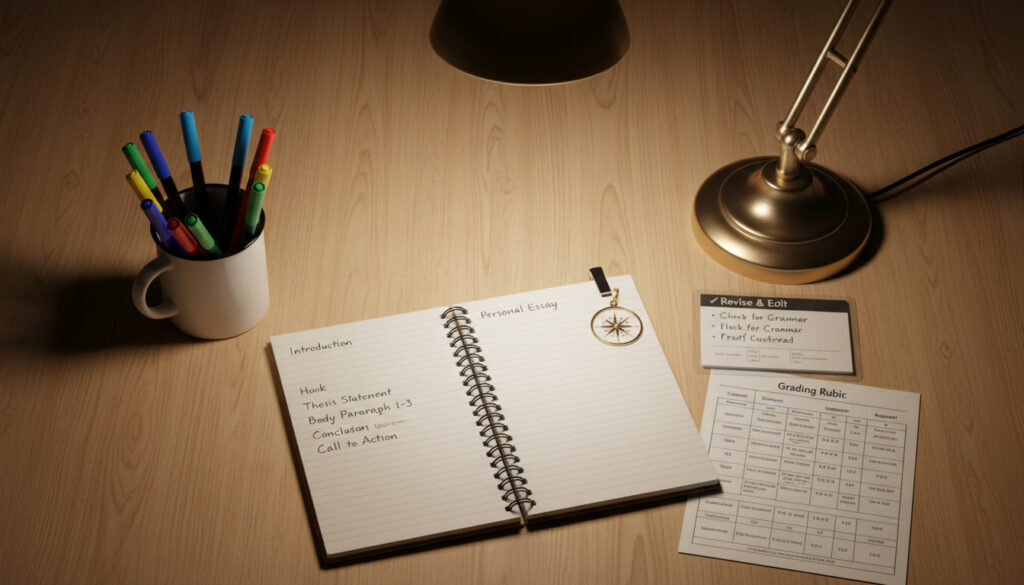
Personal Essay Leaving Cert – Structure, Tips and Marking Guide
The Leaving Certificate English examination requires candidates to demonstrate sophisticated compositional skills through varied writing tasks. Within Paper 1, Section II (Composing), students encounter the personal essay as a distinctive option that demands reflective, first-person narration rooted in authentic experience.
Unlike purely analytical tasks, this component emphasizes expressive and communicative competencies across narrative or aesthetic genres. Success depends upon balancing emotional authenticity with technical precision, requiring candidates to deploy accurate language while exploring meaningful personal insights.
The State Examinations Commission evaluates these compositions through specific criteria prioritizing coherence, linguistic appropriateness, and depth of reflection. Understanding the precise requirements separating high-scoring responses from mediocre submissions remains essential for effective preparation.
What is a Personal Essay in Leaving Cert English?
A personal essay in the Leaving Certificate context constitutes a reflective composition that articulates individual experience through a distinct narrative voice. The form distinguishes itself from short fiction or purely descriptive pieces through its explicit emphasis on internal reflection rather than external plot mechanics.
Reflective, first-person narrative exploring personal experience with analytical depth
500-600 words developed within the 2.5-hour examination timeframe
Contributes to the 100 marks available in Paper 1 Composition
Development of authentic voice balanced with original insight
Key characteristics distinguishing successful submissions include:
- Examiners prioritize authentic voice over technical perfection
- Avoidance of clichéd narratives in favor of unique personal insights
- Strategic balance between concrete anecdote and abstract reflection
- Effective time management within the 2 hours 30 minutes allocated for Paper 1
- Expressive skills demonstrating narrative or aesthetic genre awareness
- Ability to understand texts and shape responses effectively according to genre conventions
- Accuracy and appropriateness in language use across compositional stages
| Aspect | Specification |
|---|---|
| Examination Component | English Paper 1, Section II (Composing) |
| Genre Classification | Personal Writing (narrative or aesthetic) |
| Total Examination Time | 2 hours 30 minutes |
| Chief Examiner Priorities | Coherence, linguistic accuracy, analytical insight |
| Recommended Process | Pre-writing, drafting, redrafting, editing, proof-reading |
| Structural Elements | Tone, internal organization, format suited to genre |
| Cognitive Assessment | Analysis, inference, reasoning, synthesis, evaluation |
| Genre Range | Informative, argumentative, persuasive, narrative, aesthetic |
| Language Focus | Social and cultural context awareness, appropriate terminology |
| Preparation Resource | Official syllabus via Curriculum Online |
How to Structure a Personal Essay for Leaving Cert
Effective personal essays emerge from systematic composition processes rather than spontaneous generation. The State Examinations Commission emphasizes a structured approach encompassing distinct developmental phases.
The Process Approach to Composition
Candidates should implement a five-stage methodology: pre-writing (brainstorming, discussion, research), drafting (free writing, testing viewpoints, preliminary structure), redrafting (cohesive organization, genre adaptation), editing, and proof-reading. This framework ensures technical precision while preserving creative authenticity.
Structural Components
Three fundamental elements govern effective construction:
- Tone: The writer’s stance and attitude toward subject matter
- Structure: Internal organization ensuring logical progression of ideas
- Format: External layout conventions appropriate to the selected genre
Length and Time Allocation
While no strict word limit exists, effective responses typically extend to 500-600 words. Candidates must allocate time judiciously across the 2.5-hour examination, balancing planning, composition, and review phases.
Engage in free writing during initial drafting phases to test viewpoints without self-censorship, then apply cohesive organization during redrafting to ensure genre-appropriate structure.
Marking Scheme and Tips for High-Scoring Personal Essays
Assessment criteria prioritize specific competencies that distinguish exceptional compositions from adequate responses. Understanding these priorities enables strategic preparation.
Assessment Priorities
The marking scheme emphasizes accuracy and appropriateness in written language, sophisticated thinking skills encompassing analysis, inference, reasoning, synthesis, and evaluation, plus advanced reading and writing capabilities across diverse genres. Official documentation via Curriculum Online specifies these requirements.
Compositional Best Practices
Candidates should shape personal experiences or viewpoints expressively across genres, imitating models creatively while engaging real-world topics. Developing advanced composing skills requires exploring experiences while ensuring accuracy in language use.
Language awareness proves critical: analyze how word selection and organization construct meaning within social and cultural contexts, employing appropriate terminology throughout.
Common Pitfalls
Inferred weaknesses from examination guidelines include neglecting the process approach (particularly weak pre-writing or drafting phases), ignoring genre conventions and register requirements, and failing to establish cohesive organizational structures.
Failing to adapt tone and format to the specific genre selected—whether narrative or aesthetic—significantly impacts coherence marks.
Personal Essay Topics and Sample Essays for Leaving Cert
Examination topics vary annually without fixed prescription, requiring adaptable preparation strategies rather than memorized responses. For further information, you can explore Saoirse Monica Jackson’s age and husband.
Topic Selection and Availability
No specific personal essay examples or prescribed topics appear in publicly available syllabus guidelines. The curriculum stresses utilizing materials students find engaging for real-world growth, suggesting candidates draw from genuine interests and experiences.
Recent examination cycles have featured themes including change and belonging, though specific 2024 Paper 1 personal essay details require direct consultation of examinations.ie materials.
Differentiating Personal Essays from Descriptive Writing
While descriptive essays prioritize sensory detail and external observation, personal essays demand introspective analysis. The personal essay requires the writer to mine experience for universal significance, whereas descriptive writing maintains focus on surface phenomena.
Chief examiner reports and authentic past papers remain available exclusively through the State Examinations Commission website, providing essential insight into question styles and marking standards.
Evolution of Personal Writing Assessment
The personal essay component has undergone significant specification changes throughout recent Leaving Certificate history.
- Pre-2012: Composing tasks fell under broader “Composing” categories without explicit personal writing designation—source: Curriculum Online
- 2012+: Explicit specification as “Personal Writing” within Section II, distinguishing narrative and aesthetic options—source: Curriculum Online
- 2023: Chief examiner reports emphasized reflective depth and analytical insight over mere anecdotal recounting—source: St Patrick’s Comprehensive
- 2024: Examination themes centered on universal experiences including change and belonging—source: St Patrick’s Comprehensive
Established Requirements and Uncertain Variables
Distinguishing between fixed assessment criteria and variable examination elements helps focus preparation efforts effectively.
| Established Information | Information Remaining Unclear |
|---|---|
| Marking schemes and chief examiner reports are officially published via examinations.ie | Specific topics for future examination cycles remain undisclosed until paper release |
| Structure follows the mandated five-stage process approach | Precise word count expectations vary by examination paper complexity |
| Assessment prioritizes thinking skills: analysis, inference, reasoning, synthesis, evaluation | 2024-specific chief examiner feedback requires direct database access |
| Genre conventions (narrative vs. aesthetic) are consistently applied | Comparative weighting between personal essays and other composition options remains flexible |
The Role of Personal Writing in Irish Secondary Education
The personal essay serves distinct pedagogical functions within the Leaving Certificate English curriculum. By requiring students to shape personal experiences expressively, the assessment validates individual perspective while demanding technical mastery of genre conventions.
This compositional form aligns with broader educational objectives emphasizing real-world growth and communicative competence. Students must engage with topics of genuine interest, imitating professional models while developing advanced language awareness regarding how social and cultural contexts influence meaning construction. Additional strategic guidance appears through English Notes, complementing official syllabus documentation.
The assessment ultimately measures candidates’ ability to navigate between subjective experience and objective craft—a skill transferable to higher education and professional communication contexts, much like the precision required in Bon Secours Hospital Consultants – Profiles and Specialties.
Official Guidance and Examiner Insights
Authoritative direction emerges from official syllabus documentation and chief examiner analyses rather than unofficial speculation.
Chief examiner reports emphasize practicing past papers to understand question styles and marking; make reports/marking schemes available to teachers.
— Chief Examiner Report, Examination Guidelines
Composing assesses ability to understand texts, identify genres, and shape responses effectively.
— Leaving Certificate English Guidelines
Strategic Preparation for Examination Success
Mastery of the Leaving Cert personal essay requires disciplined adherence to the process approach while cultivating authentic narrative voice. Candidates should prioritize access to official examinations.ie materials, analyze chief examiner reports, and maintain rigorous peer review practices, organizing their preparation as systematically as the methods outlined in Best Photo Backup Solutions – Expert Guide for 2025, to refine compositional technique before examination day.
Frequently Asked Questions
Is first-person narration mandatory in Leaving Cert personal essays?
Yes, the personal essay requires reflective, first-person narration exploring individual experience, distinguishing it from objective or analytical compositions.
Can I use dialogue in my personal essay?
Dialogue remains acceptable within narrative genres, provided it serves the reflective purpose and maintains accuracy and appropriateness in language use.
How much time should I allocate to planning?
Effective pre-writing and drafting phases are essential; candidates should allocate sufficient time within the 2.5-hour examination to ensure cohesive organization.
Are fictional experiences acceptable?
While the personal essay emphasizes authentic experience, candidates may shape material expressively; however, genuine reflection typically carries greater emotional authenticity.
What genres constitute personal writing?
Personal writing encompasses narrative and aesthetic genres, distinct from informative, argumentative, or persuasive forms, though all require advanced composing skills.
How are personal essays marked differently from short stories?
Personal essays prioritize reflective insight and analytical depth over plot development, whereas short stories emphasize fictional narrative structure and character development.
Should I avoid specific topics?
Avoid clichéd or superficial treatments; instead, select materials you find engaging that allow demonstration of language awareness and original insight.
More related posts
 St Michael’s College Dublin – Fees, Admissions, Location Guide
 Mercy University Hospital Cork: Guide to Services & Contact
 How Digital Platforms Have Become the Newest Entertainment Source
 Iri h Government Concern Over UK Digital ID Scheme
 2026 World Cup Qualifiers: Poland’s Group G Results & Play-offs
 Saturday Night’s Main Event: Schedule, How to Watch, and Match Card
 TCD Past Exam Papers: Find & Download Free PDFs (2026 Guide)
 Green Wedding Guest Dress: Style Guide for Every Shade
