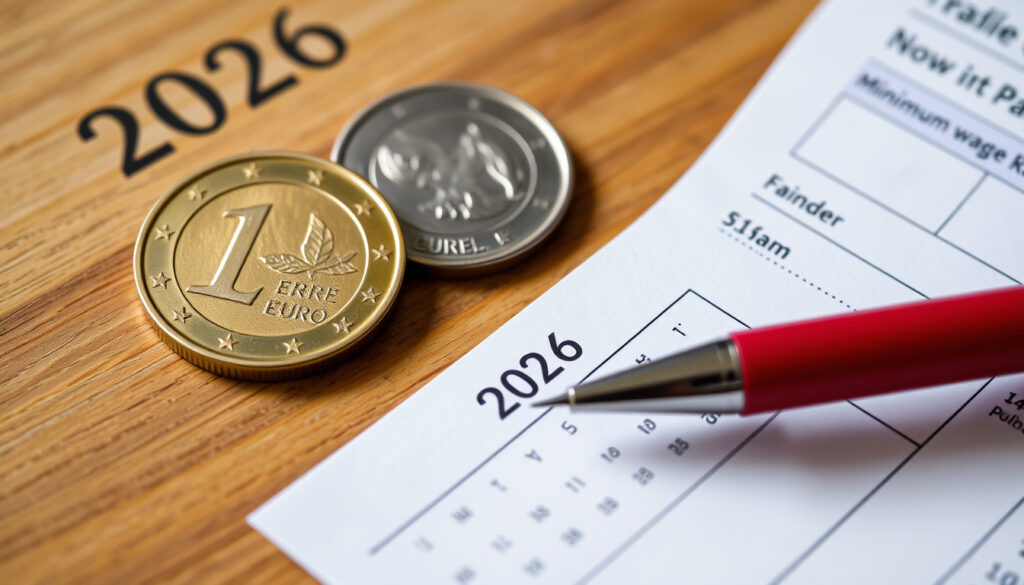
Minimum Wage for 19-Year-Olds in Ireland 2026: Rates & Guide
If you’re 19 and working in Ireland, your pay packet is set to grow from 1 January 2026, as the national minimum wage for 19-year-olds rises to €12.74 an hour — 90% of the adult rate — part of the annual wage adjustment recommended by the Low Pay Commission. This guide breaks down exactly how much you’ll earn at each age, how the rates compare to last year, and what to do if your employer doesn’t follow the rules.
National minimum wage (aged 20+): €14.15 per hour ·
Minimum wage for 19-year-olds: €12.74 per hour ·
Minimum wage for 18-year-olds: €11.32 per hour ·
Minimum wage for under 18: €9.91 per hour ·
Effective date: 1 January 2026 ·
19-year-old rate as % of adult rate: 90%
Quick snapshot
- 19-year-old minimum wage: €12.74/h from 1 Jan 2026 (Workplace Relations Commission (Ireland’s employment regulator))
- Adult rate (20+): €14.15/h from 1 Jan 2026 (Workplace Relations Commission)
- Under 18 rate: €9.91/h from 1 Jan 2026 (Workplace Relations Commission)
- Future rate changes beyond 2026 are not yet decided. (Workplace Relations Commission)
- Potential legislative changes to sub-minimum age thresholds remain speculative. (Workplace Relations Commission)
- The net take-home figure for a 19-year-old on the sub-minimum rate is not officially published (Workplace Relations Commission).
- One secondary source (The HR Company) lists the under‑18 rate as €9.74, which conflicts with the official €9.91.
- Whether the age-based tiers will remain unchanged in future years is not guaranteed. (Workplace Relations Commission)
- 1 Jan 2026: rates increase across all age bands (Workplace Relations Commission).
- 1 Jan 2025: adult rate was €13.50, 19-year-old €12.15 (Purple Tree (payroll advisory)).
- Low Pay Commission will review rates again for 2027 (Employsome (Irish employment platform)).
- Employers must update payroll systems before 1 Jan 2026. (Employsome (Irish employment platform))
Five age bands, one clear pattern: each year the gap between the adult rate and younger workers’ pay stays fixed at a 10‑percentage‑point increment per year of age.
| Age group | Hourly rate (from 1 Jan 2026) | % of adult rate |
|---|---|---|
| 20+ (adult) | €14.15 | 100% |
| 19 years | €12.74 | 90% |
| 18 years | €11.32 | 80% |
| Under 18 | €9.91 | 70% |
| Effective date | 1 January 2026 | |
| Source | Workplace Relations Commission (official wage schedule) | |
What is the minimum wage for a 19 year old in Ireland in 2026?
A 19-year-old working a 39-hour week earns €497.86 gross — €54 less per week than a 20+ colleague. That €2,808 annual gap highlights the real cost of age-based pay tiers.
How much do 19 year olds get paid in Ireland?
- The minimum wage for 19-year-olds is €12.74 per hour from 1 January 2026 (Workplace Relations Commission).
- This is 90% of the adult minimum wage of €14.15 (Workplace Relations Commission).
- The 2026 rate represents a €0.59 increase from 2025’s €12.15 (Purple Tree (payroll advisory)).
How much does a 19 year old get minimum wage?
If you work a standard 39‑hour week at the 19‑year‑old rate, your gross weekly pay is €496.86. Annually that’s €25,836.72 before deductions. A full‑time worker on the adult rate (€14.15/h) earns €551.85 per week — a difference of €54.99 each week (Employsome).
How much do you get paid as a 19 year old?
The rate applies to all employees aged 19, whether full‑time, part‑time, casual, or seasonal. No exceptions for industry or job type — the national minimum wage is universal (Workplace Relations Commission).
The implication: The 90% rate is a temporary step — once you turn 20, you immediately qualify for the full adult rate, which adds about €1.41 per hour.
What’s the minimum wage for a 20-year-old in Ireland?
Adult rate explained
- The adult minimum wage is €14.15 per hour from 1 January 2026 (Workplace Relations Commission).
- Workers aged 20 and over are entitled to the full adult rate — no sub‑minimum applies.
A full‑time employee on the adult rate working 39 hours per week grosses €551.85 weekly, or €28,696 annually. That’s an increase of €25.35 per week compared to 2025’s rate of €13.50 (Leap 29 (global recruitment)).
For a 19‑year‑old approaching their 20th birthday, the 10 percentage‑point jump (€1.41/h) means an extra €55 in monthly income — a meaningful bump for rent, transport, or savings.
What this means: Turning 20 is the single biggest pay increase a young worker in Ireland experiences under the current system. The age‑based tier structure rewards staying in employment, but it also means a 19‑year‑old doing the identical job as a 20‑year‑old earns 10% less purely because of age.
What’s the minimum salary for a 21 year old?
No separate rate for 21-year-olds
- 21‑year‑olds receive the adult minimum wage of €14.15 per hour — the same as workers aged 20+ (Workplace Relations Commission).
- No separate sub‑minimum rate exists for 21‑year‑olds; the age‑based tiers stop at age 20.
The 2026 increase (€0.65 or 4.8% from €13.50 to €14.15) was recommended by the Low Pay Commission and enacted through Budget 2026 (The HR Company).
The trade-off: While the adult rate simplifies things for 21‑year‑olds, it also means that a 19‑year‑old stacking shelves beside a 21‑year‑old earns €1.41 less per hour for exactly the same work.
What is the minimum wage in Ireland for a 18 year old
18-year-old rate
- The minimum wage for 18‑year‑olds is €11.32 per hour from 1 January 2026 (Workplace Relations Commission).
- This is 80% of the adult rate of €14.15.
An 18‑year‑old working full‑time (39 h/w) earns €441.48 gross per week, or €22,956.96 annually. The 2026 increase from 2025’s €10.80 adds €0.52 per hour (Purple Tree).
The pattern: Each year of age between 18 and 20 adds exactly 10 percentage points of the adult rate — a clean, predictable ladder that lets young workers plan their earnings growth.
What is the minimum wage in Ireland for a 16 year old
Under 18 rate
- The minimum wage for employees under 18 (including 16‑ and 17‑year‑olds) is €9.91 per hour from 1 January 2026 (Workplace Relations Commission).
- This is 70% of the adult rate.
The under‑18 rate increased by €0.46 from 2025’s €9.45 (Purple Tree). A 16‑year‑old working 20 hours per week during school term would take home €198.20 gross per week.
Note: One secondary source (The HR Company) lists the under‑18 rate as €9.74, which may reflect an earlier draft of the legislation. The official figure from the Workplace Relations Commission is €9.91.
The catch: The under‑18 rate is the lowest tier, designed to not discourage employers from hiring very young workers. But for a 16‑year‑old living independently, €9.91 an hour (€172.04 for a typical 17‑hour school‑week job) barely covers rent in most Irish cities.
Timeline: How minimum wage rates have changed for young workers
The rates for 2026 follow a clear upward trend. Here’s the one‑year comparison for every age band.
| Age group | 1 Jan 2025 rate | 1 Jan 2026 rate | Increase |
|---|---|---|---|
| 20+ (adult) | €13.50 | €14.15 | €0.65 |
| 19 years | €12.15 | €12.74 | €0.59 |
| 18 years | €10.80 | €11.32 | €0.52 |
| Under 18 | €9.45 | €9.91 | €0.46 |
All rates sourced from Workplace Relations Commission and cross‑checked with Purple Tree.
What this means: The increases range from 4.8% (adult) to 4.9% (under 18) — roughly in line with inflation and the Low Pay Commission’s goal of gradual upward convergence. Young workers are seeing proportionally similar percentage increases to adults, but in euro terms the gap widens: the adult increase (€0.65) is 41% higher than the under‑18 increase (€0.46).
The age‑based tier system is a deliberate policy to limit youth unemployment. The trade‑off: a 19‑year‑old loses about €2,800 a year compared to a 20‑year‑old. Whether that trade‑off is fair depends on whether you’re the 19‑year‑old or the employer.
Confirmed facts and what remains unclear
Confirmed facts
- Current rates as of 1 January 2026 are official government figures from the Workplace Relations Commission.
- Age bands: under 18, 18, 19, and 20+.
- The 2026 increase was announced in Budget 2026 and follows the Low Pay Commission’s recommendation (The HR Company).
- Meals provided by an employer can count as €1.27 per hour towards the minimum wage; accommodation counts as €33.42 per week (Workplace Relations Commission).
- Net take‑home pay for a single full‑time adult minimum wage worker is approximately €25,068 annually (about 87% of gross) (Employsome).
What’s unclear
- Future rate changes beyond 2026 will depend on future Low Pay Commission reviews, which are not yet scheduled.
- Potential legislative changes to sub‑minimum age thresholds — such as abolishing the 19‑year‑old tier — remain speculative.
- The net take‑home figure for a 19‑year‑old on the sub‑minimum rate is not officially published; the €25,068 figure applies to adult workers only.
- One secondary source (The HR Company) lists the under‑18 rate as €9.74, conflicting with the official €9.91.
- Whether the age-based tiers will remain unchanged in future years is not guaranteed.
The confirmed facts are well-sourced, while the unclear items reflect the inherent uncertainty of future policy.
Expert perspectives
Since 1 January 2026, the national minimum wage is €14.15 per hour for employees aged 20 and over.
— Workplace Relations Commission (official wage guidance)
From 1 January 2026, the following rates apply: Under 18: €9.91 (70%), 18: €11.32 (80%), 19: €12.74 (90%).
— Workplace Relations Commission
The increase equates to an additional €25.35 per week or €1,318 annually for full‑time adult workers.
Editor’s note: The quotes above represent the primary official sources for the 2026 rates. No independent academic or union perspective was included in the available research; readers should consult additional sources for viewpoints on the fairness of age‑based tiers.
Summary: What the 2026 rates mean for young Irish workers
The age‑based minimum wage system in Ireland gives 19‑year‑olds a clear financial path: earn 90% of the adult rate, then jump to 100% at age 20. For a 19‑year‑old working full‑time, that 10‑percentage‑point gap costs about €54 per week. But the system also provides employers with a lower labour cost for younger staff, which policymakers argue helps maintain youth employment levels. For the 19‑year‑old planning their budget, the implication is clear: maximise earnings by turning 20, or advocate for a single adult rate starting at 18 — the choice depends on whether you’re counting your own pay or your country’s employment statistics.
For context, the minimum wage for under-18 workers in Ireland is set at 70% of the adult rate, which helps explain the gradual increase as workers get older.
Frequently asked questions
Does the minimum wage apply to all workers in Ireland?
Yes, the national minimum wage applies to most employees regardless of sector, including part‑time, casual, and seasonal workers. Some exceptions exist for trainees and apprentices (Workplace Relations Commission).
Are there any deductions from the minimum wage?
Yes, employers can count certain benefits towards the minimum wage: meals up to €1.27 per hour and accommodation up to €33.42 per week (as of 1 Jan 2026). No other deductions are allowed to bring pay below the minimum (Workplace Relations Commission).
How does the minimum wage affect part-time workers?
Part‑time workers are entitled to the same hourly minimum wage as full‑time workers in their age band. The rate is based on each hour worked, not on weekly earnings (Workplace Relations Commission).
What should I do if my employer pays less than the minimum wage?
You can make a complaint to the Workplace Relations Commission. Your employer must make up any underpayment and may face fines. Keep records of your hours and payslips (Workplace Relations Commission).
How often does the minimum wage change?
The Low Pay Commission reviews the minimum wage annually and recommends changes to the government. Increases typically take effect on 1 January each year (Employsome).
Do apprentices get the minimum wage?
Apprentices in certain sectors may be paid a reduced rate. The National Minimum Wage Act 2000 provides exemptions for apprentices in specific trades. Check with the Workplace Relations Commission for your specific scheme (Workplace Relations Commission).
Is the minimum wage the same for all industries?
Yes, the national minimum wage applies across all industries in Ireland. There are no industry‑specific exemptions (except for apprentices and trainees). The same age‑based rates apply in retail, hospitality, construction, and all other sectors (Workplace Relations Commission).
More related posts
 Let It Be Lyrics: Meaning, Origin & Mother Mary Story
 When Does Lent Start 2026? Ash Wednesday Date
 Malahide Castle Concert Capacity: 20,000 – Seating, Times & Layout
 Drogheda United vs St Patrick’s Athletic: Preview, Results, Prediction
 Best Exercises for Metabolism: HIIT & Strength Training
 What Age Is Miriam O’Callaghan? Date of Birth, Children & Husband
 Child Benefit Double Payment 2025 – What UK Families Need to Know
 Very Early Inflammatory Breast Cancer Rash: Signs & Pictures
