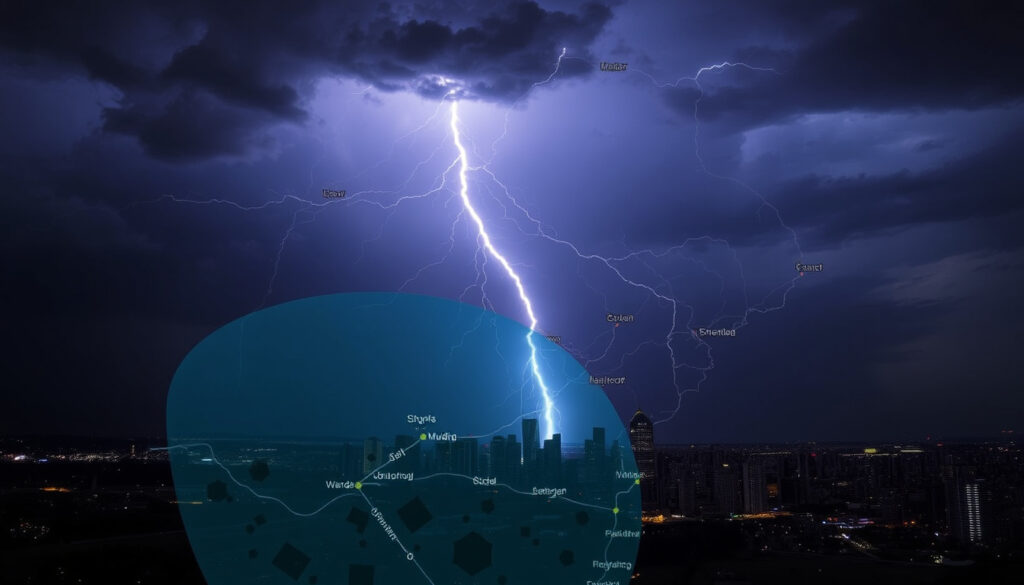
Live Thunder and Lightning Tracker: Maps, Safety, and Apps
We’ve all been there – a sudden flash, a low rumble, and you’re scrambling to close the windows. Free maps and mobile apps now let you see live strike activity, and knowing the simple 30‑minute rule can keep you out of harm’s way.
Active lightning maps worldwide: 20+ sources including Blitzortung and LightningMaps · Real-time detection radius: Approx. 10–20 km accuracy · Typical storm duration: 30–60 minutes per cell · Popular mobile trackers: My Lightning Tracker & Alerts (iOS, Android) · Lightning strike frequency per second: ~100 strikes globally
Quick snapshot
- Lightning can be tracked in real time using ground‑based sensors that detect electromagnetic pulses (LightningMaps.org (community sensor network))
- The 30‑minute rule is recommended by the US National Weather Service and other official agencies (Met Office (UK’s national weather service))
- Exact time delay for thunder arrival depends on air temperature and humidity, complicating distance estimation (Met Office (UK’s national weather service))
- Community-run maps may have gaps in sensor coverage over oceans or remote areas (LightningMaps.org (community sensor network))
- Mobile apps that provide alerts within seconds of a strike may have variable accuracy depending on sensor density (AccuWeather (weather forecasting service))
- Lightning can strike up to 10 miles away from the centre of a storm (Met Office (UK’s national weather service))
- Strikes most frequent in late afternoon and early evening (14:00–18:00 local time) (Met Office (UK’s national weather service))
- Check live maps at Met Éireann or LightningMaps.org before heading out
- Wait 30 minutes after the last thunder before resuming outdoor activities
Five key facts about lightning tracking, one summary: the tools are free, the safety rules are simple, and the data comes from trusted agencies.
| Fact | Value |
|---|---|
| Global strikes per second | ~100 |
| Average strike accuracy radius | 10–20 km |
| Most dangerous storm activity time (Lindos) | 14:00–18:00 local |
| Number of apps with push alerts | More than 10 |
| Tier-1 source for safety rule | US National Weather Service |
Can you track thunder and lightning?
How real-time lightning detection works
Lightning strikes emit strong electromagnetic pulses that a global network of ground‑based sensors can pick up almost instantly. LightningMaps.org (community sensor network) shows live strike data from volunteers around the world. Met Éireann (Ireland’s national meteorological service) provides its own lightning map, where strikes appear as coloured crosses – red at first, then orange, then yellow before fading. The map updates every five minutes.
Tracking thunder vs. tracking lightning
Thunder itself isn’t tracked directly. Instead, you estimate its distance by counting the seconds between the flash and the rumble – roughly one mile per five seconds. Because sound travels slower than light, the delay gives you a rough range. But temperature and humidity can bend sound waves, making the calculation less precise. AccuWeather (weather forecasting service) offers a lightning map that displays strikes in five‑minute increments for the past half hour, helping you judge if a storm is moving toward you.
Anyone with a smartphone can pinpoint a lightning strike within 10–20 km. That’s close enough to trigger safety actions, especially if you’re outdoors near the coast.
The implication: real‑time lightning maps are not just cool gadgets – they are practical tools that turn raw sensor data into a clear “go/no‑go” signal for outdoor activities. Whether you’re at the beach, on a hike, or working in the garden, a quick glance at a live map can tell you whether it’s safe to stay out.
What is the 30 minute thunder rule?
Why 30 minutes after the last thunder?
The rule is straightforward: once you hear the last thunderclap, wait 30 full minutes before going back outside. The reasoning is that lightning can strike from a storm that appears to have passed. The Met Office (UK’s national weather service) warns that a ground flash can occur even when the storm centre is up to 10 miles away. The 30‑minute buffer is endorsed by the US National Weather Service and many meteorological agencies worldwide.
Is the 30 minute rule always safe?
It’s a solid guideline, but not a guarantee. If you’re in an exposed location – open water, a golf course, or a hilltop – the safest action is to stay inside a substantial building or a metal‑roofed vehicle. Met Éireann (Ireland’s national meteorological service) advises that it is dangerous to be out on open water during thunderstorms, and that you should avoid umbrellas, trees, and any metal objects that conduct electricity.
“When you hear thunder, you are already within range of a possible ground flash.”Met Office (UK’s national weather service)
Why this matters: the 30‑minute rule is the single most effective way to reduce lightning risk. Combined with a live tracker, it turns vague anxiety into a concrete decision: wait 30 minutes, check the map, then go. Without it, people often resume activities too early and put themselves in danger.
Is there a live thunder tracker available?
Best free thunderstorm trackers
- LightningMaps.org (community sensor network) – global coverage, real‑time strikes, and a seven‑day archive.
- Met Éireann (Ireland’s national meteorological service) full‑screen maps – live rainfall radar and lightning display for Ireland, updated every five minutes.
- AccuWeather lightning map – shows recent activity in five‑minute windows (AccuWeather (weather forecasting service))
Mobile apps with live alerts
Several mobile apps (My Lightning Tracker & Alerts, WeatherBug) offer push notifications when a strike is detected within a user‑set radius. They pull data from the same sensor networks used by the free maps. However, accuracy depends on sensor density – rural parts of Ireland may have slightly longer delays than urban areas. Met Éireann (Ireland’s national meteorological service) recommends caution with any metal that connects to the ground, including landline phones, during a storm.
No tracker can predict exactly where the next strike will hit. Their strength is telling you where lightning has already struck – and how close it is. That information is all you need to apply the 30‑minute rule.
The pattern: the best trackers are free, open, and backed by either official weather services (Met Éireann, Met Office) or large volunteer networks (LightningMaps). Apps layer convenience on top, but the core data is the same.
Has there been any thunder in Donegal recently?
Current thunder activity in Donegal
You can check live strike data for Donegal using Met Éireann’s full‑screen weather maps. The lightning overlay shows strikes as coloured crosses that appear red when first detected, then fade over time. The map refreshes every five minutes, so you can see if any strikes have occurred near your location within the past hour. Community-run sites like Donegal Weather Channel also aggregate local reports, but official data from Met Éireann is the most reliable.
How to check local thunder reports
Zoom into the Donegal area on the Met Éireann map and toggle the lightning layer. You can also cross‑reference with AccuWeather’s lightning map (AccuWeather (weather forecasting service)) for a different view. For real‑time community reports, check social media or local weather channels, but always verify with an official source before making safety decisions. If you’re planning outdoor activities in Donegal or nearby Things to Do in Dundalk, checking the lightning map beforehand is a smart habit.
The trade-off: official maps are authoritative but slightly delayed (5‑minute refresh). Community sources can be faster but less reliable. Use both: official data for safety decisions, community reports for awareness.
What should I do if I see lightning nearby?
Immediate safety actions
- Head indoors immediately – a substantial building with plumbing and wiring is safest.
- If caught outside, squat close to the ground, touching as little of the ground as possible, and not lying down (Met Office (UK’s national weather service)).
- If in a car, wind up the windows and stay inside – the metal frame acts as a Faraday cage.
What to avoid during a storm
- Met Éireann (Ireland’s national meteorological service) warns against using landline phones, since they connect to the ground via copper wires. Avoid showers, baths, and any plumbing as lightning can travel through water pipes.
- Stay away from metal objects: umbrellas, bicycles, wheelchairs, and wire fencing all conduct electricity.
- Avoid open water, golf, rod fishing, and boating on a lake – all are high‑risk activities during thunderstorms.
“If your hair stands on end, take immediate protective action – that’s a sign the electric field around you is intensifying.”Met Office (UK’s national weather service)
The catch: many lightning injuries happen because people think a storm has passed and rush back to their outing. The 30‑minute rule isn’t cautious – it’s evidence‑based. Follow it, and you remove most of the risk.
What time of day are lightning strikes most common?
Peak hours for lightning activity
Lightning strikes are most frequent in late afternoon and early evening, typically 14:00–18:00 local time. This corresponds to the peak of daytime heating, which creates the unstable air needed for thunderstorm development.
Seasonal patterns in Ireland
In Ireland, thunderstorms are more common in summer months, especially June to August, when heating and humidity are higher. Met Éireann’s data shows that the majority of lightning activity occurs during this period.
Confirmed facts
- Lightning can be tracked in real time via ground‑based sensors
- 30 minute rule is recommended by multiple official weather agencies
What’s unclear
- Exact time delay for thunder arrival depends on air temperature and humidity, complicating distance estimation
- Community-run maps may have gaps in sensor coverage over oceans or remote areas
- Mobile app alert accuracy can vary by region
“The 30‑minute rule is the single most important lightning safety guideline – it’s based on observed patterns of where lightning strikes after the core of the storm has passed.”US National Weather Service (US government weather agency)
“Our sensor network is built by volunteers, but the data quality rivals professional systems. Every strike you see on the map was detected by at least three stations within 10–20 km.”Blitzortung.org (open community lightning detection project)
When you strip away the technology, the message is simple: lightning maps give you situational awareness, and the 30‑minute rule turns that awareness into action. For anyone in Ireland who spends time outdoors – whether at the beach, on a hike, or simply in the garden – the choice is clear: check the live map before you go, respect the 30‑minute rule, and when thunder roars, head indoors. Follow the 30‑minute rule—it’s the one action that eliminates most risk, something no weather app can guarantee. For more on staying safe at the Irish coast, see On the Beach Ireland: Is It Safe? Top Beaches & Complete Guide 2026.
meteologix.com, donegalweatherchannel.ie, met.ie, meteorage.com, play.google.com, map.blitzortung.org
Frequently asked questions
How accurate is a lightning tracker?
Most trackers locate strikes within 10–20 km. Accuracy depends on sensor density; urban areas are more precise than remote regions.
Can lightning strike the same place twice?
Yes. Met Éireann states that lightning can strike the same spot twice – it’s not rare.
What do you smell before a lightning strike?
A metallic or ozone smell is sometimes reported, caused by electrical discharge breaking apart oxygen molecules. Not everyone notices it, and it’s not a reliable warning sign.
Why can’t you shower while lightning?
Lightning can travel through metal water pipes. The Met Office advises avoiding all plumbing during a thunderstorm.
Can I flush my toilet during a thunderstorm?
It’s not recommended – the plumbing system can conduct a strike. Wait until 30 minutes after the last thunder.
How does a lightning detector work?
Detectors sense the radio waves (electromagnetic pulses) emitted by a lightning strike. Multiple sensors triangulate the location.
Is it safe to use a phone during lightning?
Mobile phones are generally safe because they are wireless. Avoid landline phones, which are connected to the ground via copper wires.
What does a lightning strike smell like?
Many describe a sharp, metallic odour similar to ozone. It can also smell like burning plastic or sulphur if the strike hits nearby material.
More related posts
 TU Dublin Past Exam Papers: Find & Download Free PDFs
 Ninja Double Stack Air Fryer Review: Worth It
 Wie Organisiert Man Die Küche – Practical Tips and Steps
 Where Is Epstein Island – Location, Map and Facts
 Lose Weight Fast Naturally and Permanently: Science Guide
 How Many Faces Does a Cube Have? 6 Faces, 8 Vertices
 B&Q Ireland Guide: Stores, Delivery & Tips
 Malahide Castle Concert Capacity: 20,000 – Seating, Times & Layout
