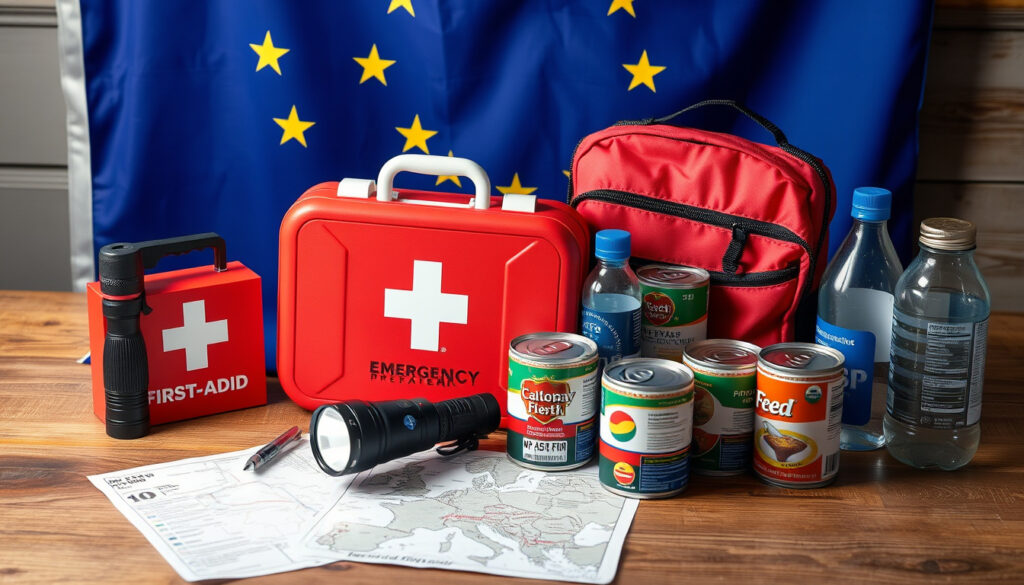
EU Stockpile Supplies: 72-Hour Emergency Kit & Prep Strategy
The idea of keeping a few days’ worth of food and water at home might sound like a holdover from Cold War preparedness pamphlets. For the 450 million people living in the European Union, it’s about to become official guidance. In March 2025, the European Commission unveiled its Preparedness Union Strategy, which explicitly urges households to stockpile essentials for at least 72 hours. This directive is part of a broader effort to strengthen the bloc against hybrid attacks, pandemics, and natural disasters — a systematic overhaul rather than a panic measure.
Population advised to stockpile: 450 million EU citizens · Suggested duration of supplies: 72 hours (3 days) · Key items recommended: Food, water, medicine, fuel, cash · Primary reason for advice: Crisis readiness (hybrid threats, pandemics, disasters) · EU member states involved: 27 countries · Official strategy launched: 2025 (EU Stockpiling Strategy)
Quick snapshot
- EU Preparedness Union Strategy presented March 2025 European Commission (EU executive body)
- Strategy urges 72‑hour self‑sufficiency for households European Commission press release IP/25/856
- rescEU network coordinates medical stockpiles European Commission press release IP/25/856
- Member states asked to review national reserves July 2025 Euronews (European news network)
- Whether citizens will fully comply with the 72‑hour recommendation
- How tariffs will affect specific product prices and supply chains
- Exact timeline for full implementation of all strategy components
- 2020 – COVID‑19 exposes gaps in EU medical stockpiles
- 2022 – Russian invasion of Ukraine triggers energy and supply chain crises
- March 2025 – Commission presents Preparedness Union Strategy
- July 2025 – Member states asked to review their own reserves
- EU Stockpiling Strategy coordination across 27 member states
- National reserve reviews and identification of gaps
- Citizen‑facing preparedness campaigns and guidelines
The 72‑hour kit is not just a household checklist; it’s the visible tip of a €1.2 billion EU‑wide stockpiling architecture that links rescEU medical reserves, energy emergency stocks, and civil protection mechanisms.
Six key facts summarise the reality of EU stockpile supplies.
| Label | Value |
|---|---|
| EU citizens advised | 450 million |
| Recommended stockpile duration | 72 hours (3 days) |
| Official strategy year | 2025 |
| Key items | Food, water, medicine, fuel, cash |
| EU stockpiling network | rescEU |
| Member states | 27 |
Why is the European Union telling citizens to stockpile food?
The EU is preparing for threats that simultaneously strike all 27 member states — an attack pattern no single country can handle alone.
Hybrid threats and geopolitical tensions
- The Commission’s strategy cites “geopolitical tensions, conflicts, cybersecurity risks, information manipulation” as key drivers. European Commission – EU preparedness union strategy
- Russia’s war on Ukraine revealed how energy dependency can be weaponised.
Lessons from COVID-19 and natural disasters
- COVID‑19 exposed severe gaps in EU medical stockpiles, prompting the rescEU reserve. European Commission press release IP/25/856
- Climate change increases frequency of floods, wildfires, and storms that disrupt supply chains.
Energy and supply chain vulnerabilities
- The 2022 energy crisis and 2023 inflation spikes showed how fragile cross‑border logistics can be. Euronews (European news network)
The implication: The 72‑hour stockpile is the household‑level response to threats that the EU cannot fully shield citizens from at the border.
What items has the EU advised citizens to stockpile?
The Commission’s guidelines are deliberately broad — no one‑size‑fits‑all list, but a set of categories that each household must tailor.
Food and water
- Minimum 3 days of non‑perishable food (canned goods, rice, pasta, energy bars).
- At least 2 litres of water per person per day — that’s 6 litres per person for 72 hours. European Commission – EU preparedness union strategy
Medicines and first aid
- Prescription medicines stored with a backup supply if possible.
- Basic first‑aid kit (bandages, antiseptic, pain relievers).
Cash and documents
- Enough cash to cover 3 days of expenses (ATMs may be down).
- Important documents in a waterproof bag (ID, insurance, medical records).
Fuel and heating
- Portable gas stove or camping cooker (ensure fuel stored safely).
- Warm blankets and extra clothing in case of heating failure.
Communication tools
- Battery‑powered radio (DAB/FM) for emergency alerts.
- Flashlight and spare batteries, plus a power bank for phones.
What this means: The list is designed to be affordable and achievable for most households — a basic survival buffer, not a bunker.
What to stockpile for 72 hours?
Building a 72-hour emergency kit
- Start with food, water, first aid, and tools. European Commission guidelines
- Add multi‑tool, cash, phone charger, whistle, dust masks.
- Store kit in a cool, dry place accessible in 5 minutes. Euronews (European news network)
Prioritizing essentials
- Water tops the list — without it, humans survive only 3 days.
- Food should require no cooking if power is out.
Storage and rotation tips
- Rotate food and water every 6 months.
- Check expiration dates on batteries, medications.
The pattern: A 72‑hour kit is a cheap insurance policy — the cost of replacing stale items once a year is negligible compared to the value of being self‑sufficient during the first critical days.
What to stockpile in case of WW3?
Nuclear threat considerations
- Iodine tablets for radiation protection (follow local health guidance).
- Sealed food and water for an extended period — 72 hours is a minimum, not a maximum.
Shelter and protection supplies
- Duct tape and plastic sheeting to seal a room (shelter‑in‑place).
- Battery‑operated radio for emergency alerts. European Commission – EU preparedness union strategy
Long-term food storage
- Freeze‑dried meals, canned goods with long shelf lives (5+ years).
- Water purification tablets or a portable filter.
The trade‑off: Preparing for the most severe scenario (nuclear conflict) overlaps heavily with preparing for everyday emergencies — a 72‑hour kit that works for a storm also works for a war.
What are the top 10 foods to stockpile?
- Canned vegetables, beans, and meat (protein + fibre).
- Rice, pasta, oats (calorie‑dense staples).
- Peanut butter, nuts, energy bars (no refrigeration needed).
- Freeze‑dried meals (long shelf life, just add water).
- Water purification tablets (backup if taps stop flowing).
- Baby formula if you have an infant.
- Pet food for four‑legged family members.
- Coffee, tea, spices (morale boosters, not strictly necessary).
- Multivitamins (to compensate for limited fresh produce).
- Cooking oil and salt (basics for preparing dry staples).
Why this matters: A balanced 3‑day food supply covers nutritional needs while fitting in a single cupboard — no need for a second freezer.
What items should I stockpile before tariffs?
Understanding tariff impact
- Tariffs raise prices on imported goods; stockpiling before deadlines can lock in current prices. Euronews (European news network)
Electronics and appliances
- Big‑ticket items (laptops, washing machines) imported from outside the EU may become more expensive.
- Consider buying before tariff deadlines if you can afford it.
Food and household goods
- Non‑perishable imports like coffee, spices, and olive oil could see price hikes.
- Stockpile items you use regularly in deep rotation.
The catch: Tariff‑driven stockpiling is a one‑time buying spree, not a sustainable strategy — focus on the items most exposed to import duties.
Timeline: How the EU stockpile strategy evolved
- 2020: COVID‑19 pandemic reveals gaps in EU medical stockpiles. European Commission – EU preparedness union strategy
- 2022: Russian invasion of Ukraine triggers energy and supply chain crises. European Commission – EU preparedness union strategy
- 2024‑2025: EU develops Stockpiling Strategy to secure essential goods. European Commission – EU preparedness union strategy
- July 2025: EU officially announces Stockpiling Strategy and medical countermeasures. Euronews (European news network)
The Commission’s strategy is a framework, not a law — each member state decides how to implement it. Citizens should watch their national civil protection agency for specific guidance.
The strategy’s success hinges on national implementation, with each country adapting the framework to local needs.
What’s confirmed — and what’s still unclear
Confirmed facts
- EU issued official guidance to citizens to stockpile 72 hours of essentials. European Commission press release IP/25/856
- EU Stockpiling Strategy exists and integrates rescEU. European Commission – EU preparedness union strategy
- Member states are encouraged to coordinate national stockpiles. Euronews (European news network)
What’s still unclear
- Whether citizens will fully comply with the recommendation.
- How tariffs will affect specific product prices and supply.
- Exact timeline for implementation of all strategy components.
“The strategy calls for minimum preparedness requirements, a revised Union Civil Protection Mechanism, and an EU stockpiling strategy.”
— European Commission, press release IP/25/856
“The Commission’s preparedness strategy aims to enhance both civilian and military preparedness so that all actors can respond quickly and effectively.”
— European Commission – EU preparedness union strategy
The stakes are clear: Europe’s 72‑hour stockpile advice is a milestone in civilian preparedness, but its success depends on each of the 450 million citizens actually keeping a kit at home. For the Irish reader, the same logic applies — the Beast from the East in 2018 showed how quickly supply chains can freeze. Start with a simple checklist: water, food, cash, batteries. The EU has done its part; now it’s up to households to turn the guidance into action.
Related reading: The Beast from the East – 2018 Cold Wave Explained · Ireland 2025 Social Welfare Payment Hikes: Rates & Bonuses
Frequently asked questions
Do I need to stockpile for 72 hours?
The European Commission recommends every household maintain enough supplies to be self‑sufficient for at least 72 hours during any major crisis. It’s not mandatory but it is strongly advised.
Is the EU stockpile advice mandatory or just a recommendation?
It is a recommendation. Each member state decides how to implement the strategy. Some may issue more specific guidance or national laws.
What is rescEU and how does it help?
rescEU is the EU’s strategic reserve of medical equipment, vaccines, and other critical supplies. It supplements national stockpiles and can be deployed quickly across borders.
Where can I find the official EU list of recommended supplies?
The Commission’s preparedness strategy page provides general categories. National civil protection agencies often publish detailed lists.
How often should I update my emergency kit?
Rotate food and water every 6 months. Check batteries, medications, and expiration dates annually.
Can I use the same supplies for a WW3 scenario?
Yes — a 72‑hour kit for a natural disaster also works for conflict scenarios. Add iodine tablets and duct tape for radiological threats.
What are the best foods to stockpile that last long?
Canned goods, rice, pasta, freeze‑dried meals, peanut butter, and energy bars. Avoid items that require refrigeration or have short shelf lives.
How will tariffs affect the cost of stockpiling?
Tariffs raise prices on imported goods. Stockpiling before tariff deadlines can save money on electronics, coffee, spices, and other non‑perishables.
More related posts
 Carpal Tunnel Syndrome Treatment: Symptoms, Red Flags, Surgery
 Personal Essay Leaving Cert – Structure, Tips and Marking Guide
 Newcastle United vs Man City Timeline: Key Results & History
 Michael Conlan Next Fight: Date, Opponent & How to Watch
 Dyson V Hand Dryer: Specs, Worth It, Problems & Guide
 Social Welfare Payment Early Deposit Ireland: Dates & Amounts
 Bon Secours Hospital Consultants – Profiles and Specialties
 Rip.ie Recent Deaths Dublin – Latest Notices and Funeral Details
